
Something big is happening to the social media career ladder, and I don't think our industry has properly reckoned with it yet.
At SocialDay, we're in the middle of building what I believe will be the most comprehensive piece of research ever done on the social media profession. We're calling it the State of Social Media Careers 2026, and it's been a long time coming. I've been sitting down with senior practitioners, consultants, hiring managers, and academics, one conversation at a time, pressure testing our career framework and gathering the kind of honest insight you only get when people are speaking freely. Alongside those conversations, we're surveying hundreds of people working in social media right now to get the data that backs it all up.
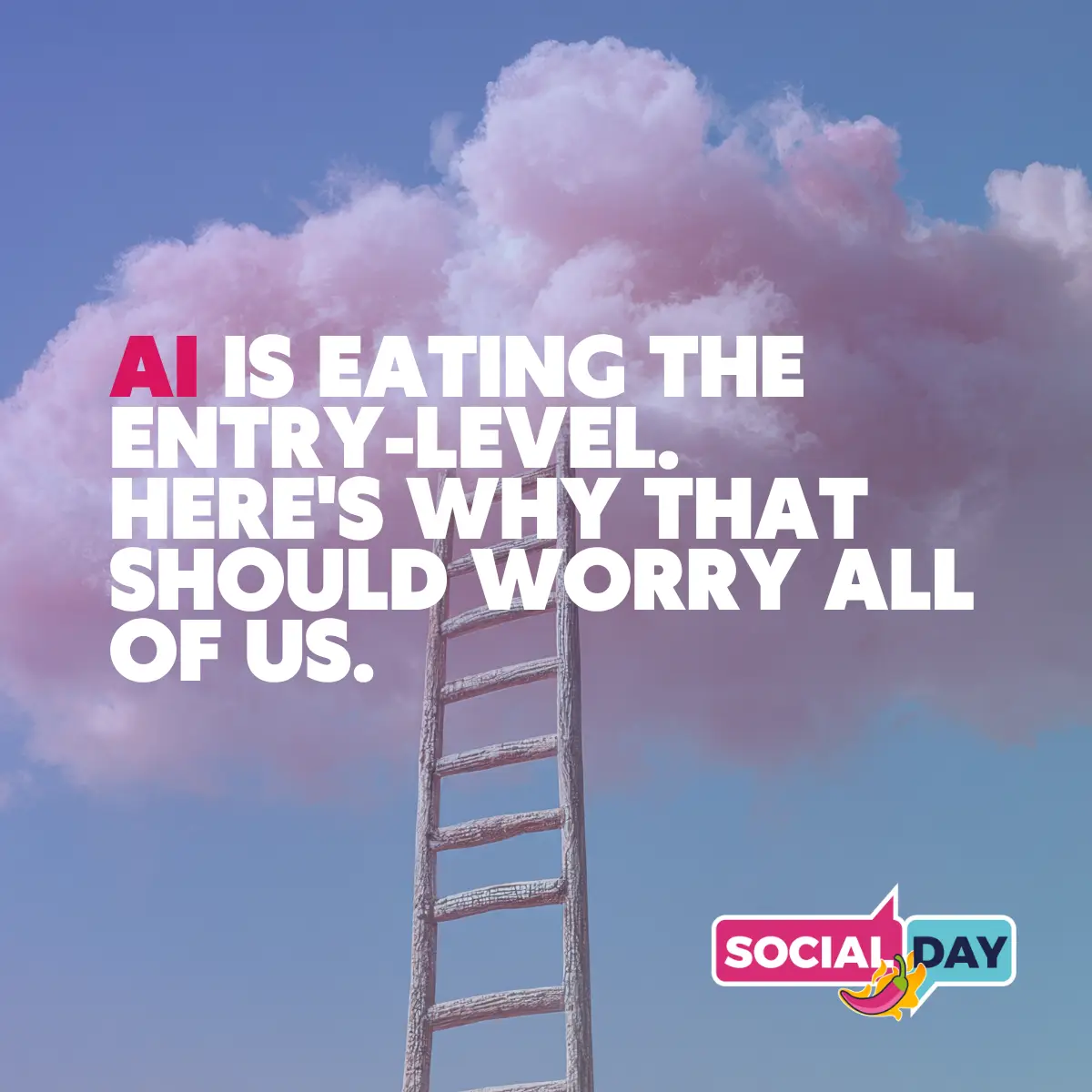
One theme has come up in pretty much every single conversation I've had so far. AI is replacing or compressing entry-level social media roles faster than new ones are being created. And the knock-on effects for the whole profession are enormous.
Katy Howell, CEO of Immediate Future, put it plainly. The first rung of the career ladder is either already being replaced by AI or it will be very soon. In her agency, the analyst role (one that previously took days to process unstructured data) has already become obsolete because AI does it in minutes. Scheduling, first-pass drafts, basic reporting: all going the same way.
So that raises a pretty uncomfortable question. If the traditional apprentice-level role disappears, how do people actually get in? And how do they develop the judgment and taste that can't be outsourced to a model?
The answer isn't to panic. What Katy is clear on, and it's something I'm hearing across all my conversations, is that what AI genuinely can't replicate is strategy, taste, and the ability to ask the right questions. "AI produces vanilla content," she told me. "It's genuinely poor at high-level strategy because it struggles with the questions you need to ask about business risk and opportunity when an algorithm changes."
AI produces vanilla content
Carolina Barbosa, social media strategist and consultant, adds a really important dimension to this. Junior talent's value lies in their cultural immersion. They're spending more time on platforms than any senior person focused on high-level strategy. That's the "juice," the unique cultural insights and instinct for what's actually resonating, that AI consistently gets wrong. The real danger is that if we skip the entry-level entirely, we lose the pipeline that develops that instinct over time.
And I think that's the conversation we need to be having as an industry. Strategic thinking can't stay locked at Stage 3 of the career ladder. It needs to come down. Junior people need to understand why content works, not just how to execute it, because execution alone is not going to be their competitive advantage for much longer.
What this means if you're a practitioner
If you're early in your career, the most important thing you can do right now is start thinking strategically, even if your job title doesn't ask you to yet. Learn how to connect what you're posting to business goals. Understand why the content works, not just that it does. Ask questions in briefs that go beyond the brief itself. AI can replicate the output. It can't replicate the thinking behind it.
If you're mid-career, this is the moment to position yourself as the person who knows how to work with AI rather than alongside it. That means having a clear point of view on what AI should and shouldn't be used for in your team, and being able to articulate that upward.
What this means if you're a hiring manager
The Stage 1 role isn't going to disappear overnight, but it is going to look different. The assistant who spends their days scheduling posts is increasingly a role you don't need. The junior who can bring cultural instinct, platform knowledge, and creative judgment? Still absolutely essential. Start writing job descriptions that reflect that distinction.
We're building the definitive picture of where social media careers stand right now. This is the first research of its kind and I want as many voices in it as possible.
Fill in the survey and help us shape the State of Social Media Careers 2026 report: socialday.live/career-survey
It takes less than 5 minutes and every answer genuinely counts.