

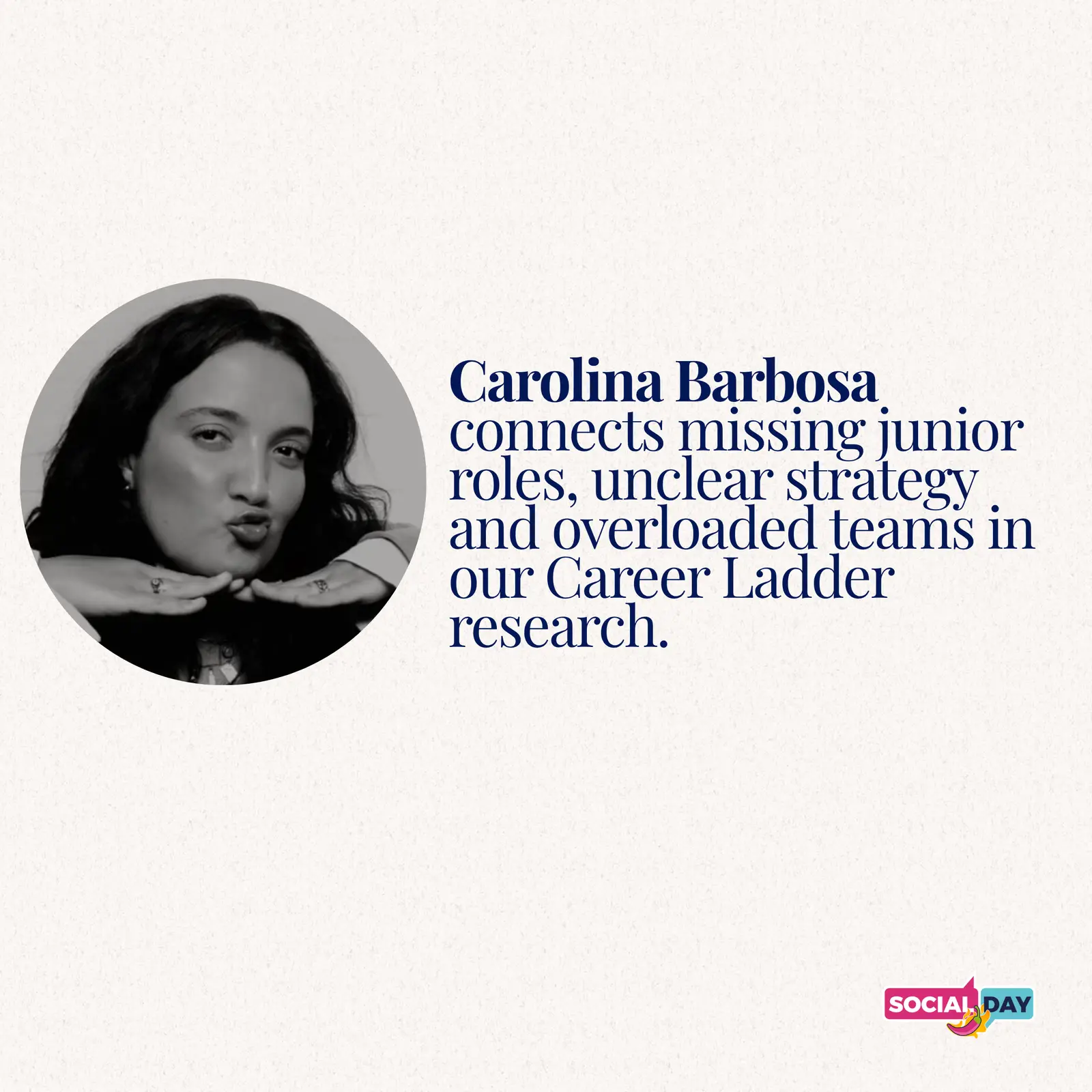
Carolina Barbosa is a Senior Social Strategist & Brand Consultant, and she has been one of the most quoted contributors to this research so far, partly because she is unusually willing to talk about burnout in specific rather than general terms. What she gave us in this conversation is the clearest causal account anybody has offered of why the burnout in this profession happens where it happens.
The Rung That Should Exist and Doesn't
Carolina's starting position on our framework is that the lowest rung is increasingly being skipped. The market, as she sees it, moves people almost straight into executive or coordinator roles, and companies routinely ask for experience that somebody straight out of university does not have and cannot have.
Her verdict is that stage one roles should exist, and that the fact they are being missed in the current market is a major flaw.
That matters because of what follows from it, which is the part of her argument I think is the most important thing in this interview.
Why Burnout Peaks at Manager Level
Carolina identifies the social media manager and senior manager stage as where the most severe burnout occurs, and her explanation is structural rather than personal.
Because stage one has been skipped, the person at manager level is expected to handle execution, strategy and everything in between simultaneously. The work that a junior role would have absorbed did not disappear when the junior role did. It simply moved upwards onto somebody who is also responsible for the thinking.
Layered on top of that, she observes that companies frequently lack defined workflows, clear processes and any realistic sense of what one person can deliver, and that hustle culture, which glorifies overworking, makes the whole thing harder to push back against.
Then she adds the part that turns pressure into futility. Businesses adopt language like building a community without connecting it to any core business goal such as acquiring paying customers, and because the executives above have often not understood social media in the first place, unrealistic demands get passed down to people who are already at capacity and who are simultaneously doing the executing, the editing and the strategy.
That is a complete mechanism, and it explains why resilience training and wellbeing initiatives do not touch this problem. Nothing in that chain is about the individual's capacity to cope.
The Vibes Problem
The skills gap Carolina describes is specific, and it is about how decisions get made rather than about craft.
Her concern is that people building strategy are frequently relying on vibes rather than on data, and that they struggle to set and calculate meaningful KPIs, precisely because they have never been exposed to strategic conversations. That is not a criticism of the practitioners. It is a description of what happens when somebody is handed strategic ownership without ever having sat in a room where strategy was made.
She confirmed what several consultants have told us, which is that a great many businesses operate for years without a coherent strategy at all, and that a consultant coming in has to audit the business structure and internal dynamics before building anything new.
Her recommendation for how strategy should be developed is one that any organisation could implement tomorrow, which is that it should not be done in isolation. Paid and creative teams should be in the planning sessions so that everything aligns, rather than social producing a plan and then handing it outwards.
She also named the underlying knowledge gap directly. Many people entering social media marketing do not understand marketing or the commercial implications of their work, and the link between content, business goals, KPIs and making money is rarely taught at university. She sees it as a mindset shift that has to be emphasised for anybody entering the industry.
What Junior Talent Is Actually For
On AI, Carolina drew a line that is worth holding on to. AI is useful for executing small tasks, and it does not replace original strategic thinking or taste, meaning the ability to tell the difference between what is good and what is merely average.
Her argument for junior talent is not that they are cheap labour for the executional work. It is that they are culturally immersed in a way senior people are not, because they spend far more time on the platforms than colleagues who are focused on high level strategy. She describes what employers should be looking for as the juice, meaning the unique cultural insight that younger practitioners hold, and warns that optimising everything with AI tends towards generic output instead.
Her corresponding advice to junior practitioners is to be vocal, to bring new ideas to the table, and to understand why content works rather than stopping at vanity metrics.
She also raised something practical, which is that the initial screening of CVs at large organisations is now frequently done by AI. That means a CV has to contain the right keywords to survive the first cut, which sits awkwardly against the instinct to make a creative CV stand out. Her view is that candidates need real support with this, because a great many are being rejected at the first hurdle for reasons that have nothing to do with their ability.
The Context Junior People Need
Carolina was clear that not everybody needs to work from an office. However, people early in their careers, or new to a team, do need access to the conversations and context surrounding the work. Being physically present can make that easier during onboarding, brainstorms and collaborative moments, but remote work can provide the same access if junior people are included in those conversations rather than simply being given a deck afterwards.
She was strongly in favour of bringing junior people into brainstorms, strategic planning sessions, and relevant senior conversations, whether those happen in person or remotely. Her reasoning is one I have repeated in almost every conversation since. They are the ones executing the campaigns. They need to understand not only what was decided, but why.
Girls, Women, and the Glamour Problem
On the profession's perception problem, Carolina identified the industry's own content as part of the cause. The glamour is perpetuated on social media in order to get attention, and it creates expectations that are completely at odds with the reality of working inside a business.
Her practical suggestion for how the profession talks about itself is small and I think genuinely effective. Address practitioners as business women rather than as girls, and stop using the terminology that does the devaluing.
What Fast-Moving Environments Can Teach You
The conversation ended somewhere I had not expected. Comparing roles at startups and agencies with those at larger organisations, Carolina noted that fast-moving environments can expose people to an unusually broad range of work very quickly. A social lead at a startup, for example, may find themselves working across areas that would be split between several roles in a larger business.
That breadth can accelerate development, but it should not be romanticised. The same environments can create unsustainable workloads and burnout, and those are not prerequisites for progression. There is a difference between being stretched by broad exposure and being overloaded because an organisation has failed to resource a role properly.
That distinction matters for this research. A useful career framework has to recognise the value of breadth and exposure without treating exhaustion as the price somebody has to pay to become senior.
What This Means for You
If you're a social media manager:** if you are exhausted, Carolina's account is worth reading as a description of a structural problem rather than a personal one. You are very likely doing two rungs of work because the rung below you was never filled, in an organisation that has not defined its workflows and may not have connected its own social media goals to its business goals. Naming that clearly, with the specifics of what you are carrying, is a more productive conversation with your leadership than asking for more time.
If you're a hiring manager or a leader:** if you skipped the entry level hire, check where that work actually went, because it went somewhere. And if you are asking your social team to build a community, be able to say what that community is for commercially, because if you cannot, the person receiving that brief has been set an impossible task and will be held responsible for the result.
We're building the most comprehensive piece of research ever done on the social media profession, and conversations like this one are exactly why this project matters. If you work in social media, at any level and in any kind of organisation, I want your voice in the data too.
Fill in the survey: socialday.live/career-survey
It takes less than five minutes and every response counts.
Carolina Barbosa is a Senior Social Strategist & Brand Consultant. This article is based on an interview conducted on 30 March 2026 as part of SocialDay's Social Media Career Ladder research. All statements have been reviewed and approved by the contributor prior to publication.