
Communications professionals spend their working lives making other organisations sound clever, warm and human, and very rarely get the same treatment themselves. Comms Creatives decided to fix that, and to do it on every platform at once.
Rather than building another feed full of tips and trends, the team built something closer to a staffroom, a bright yellow corner of the internet where comms people could recognise their own job in public, laugh at the parts nobody outside the profession understands, and remember why they got into the work in the first place.
The effect that created has a name. The Yellow Chair Effect comes from an Academy member telling the team, entirely unprompted, that she had spotted an ordinary yellow chair in a doctor's waiting room and immediately thought of them. It is the kind of association most organisations spend serious budgets trying to manufacture, and it was built here with two full-time staff, a handful of trusted freelancers, no agency and no media budget.
Marketing to people who write pitches for a living
The problem with marketing to comms professionals is that they write pitches for a living, so they can spot one from a distance and scroll straight past it. Comms Creatives stopped pitching altogether.
In its place the team built a five-stage framework it calls the Joy Ladder, which moves someone from finding their people all the way through to feeling part of a community rather than someone who simply buys courses, with a genuine payoff at every step rather than a sales pitch held back until the end.
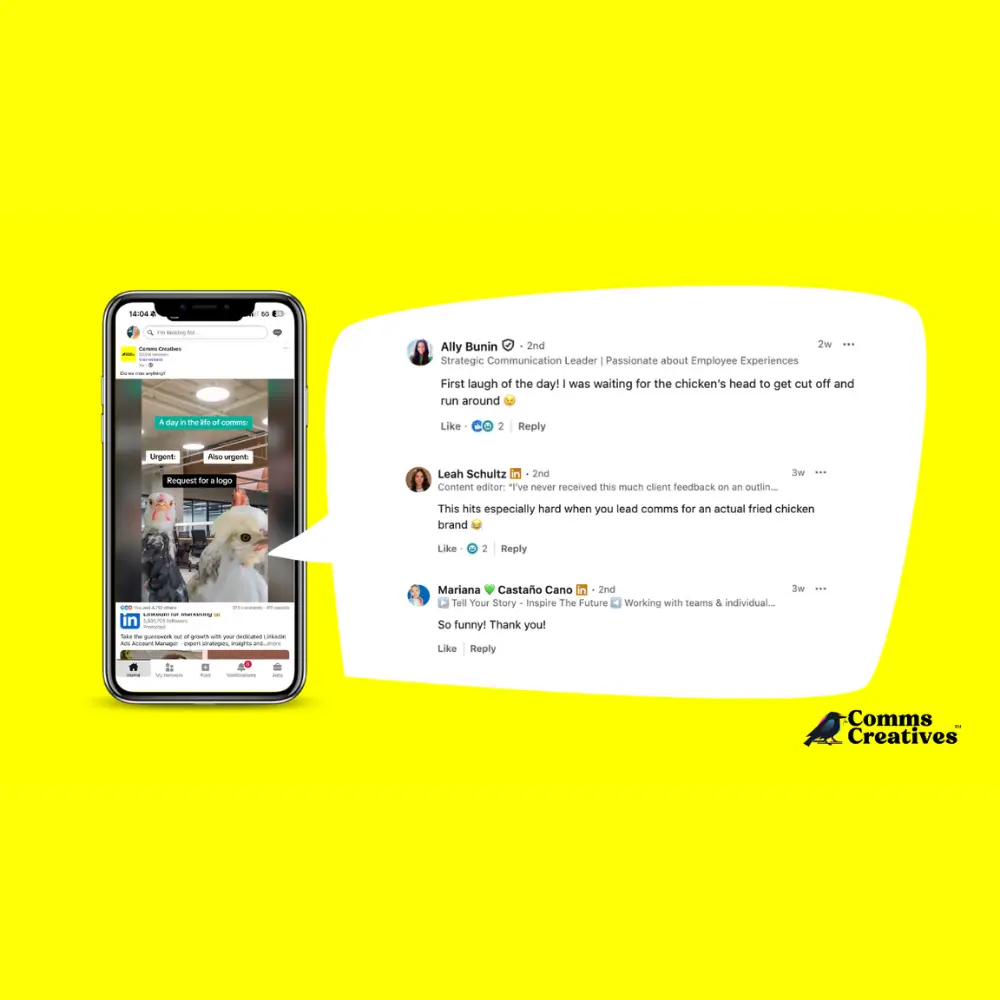
In practice that has meant recreating film scenes as comms disasters, including a Gladiator post that landed the experience of drafting a strategy nobody read so precisely that it picked up 328 comments of people posting their own war stories. It has also meant turning two bewildered chickens into a comms team juggling urgent requests, and asking the audience what job they would do if they could not work in comms, then getting out of the way while they argued about whether dog stroker counts.
The comments section is treated as content in its own right, on the basis that the best posts only really finish when someone else adds the punchline. The commercial ask comes last, once people already like the brand.
A deliberate bet on joy over tips
Every small business account is competing for the same few inches of feed with the same brisk corporate voice, aimed at an audience trained to ignore it. Comms Creatives chose a different fight, betting on joy and recognition rather than trying to out-tip and out-trend a market already saturated with both, and offering proof that creativity is still allowed inside organisations that feel bound by rules and risk.
That is a riskier bet for a company this size than it sounds, because a five-person operation with no agency and no marketing department has more to lose from a post that fails than a large brand does. The team took the risk in public and under its own name, on the grounds that it teaches comms professionals to be braver and more creative, and the only credible way to say that is to go first.
The business is run by sisters Hel and Lesley Reynolds, with part-time support from their mum and a small band of trusted freelancers and tutors, fewer than ten people in total. Hel leads on training, strategy and content, having trained more than 5,000 comms, PR and marketing professionals from organisations including BBC Studios, Rolls Royce, Cambridge University, Cats Protection and Yeo Valley, and having spoken at CommsHero for eleven consecutive years. Lesley is Business Manager, looking after clients and members while handling video and web editing behind the scenes. Jessica Roberts, Zander Mills, Luan Wise and Caroline Buist are the Academy's resident experts, working alongside a rotating cast of guest tutors.
What a yellow corner of the internet adds up to
The numbers built by that group are considerable. The LinkedIn company page has 53,608 followers and 5.67 million impressions this year, with 20,480 new followers gained and 18,126 of those organic. TikTok has delivered 1.4 million views with 403,800 new viewers, 88.1% of that traffic arriving from the For You page and therefore from people who had never heard of the brand before.
Elsewhere, Instagram Reels reached 203,000 views and 56,000 viewers in a single 60-day window, Facebook followers rose 21.6% with engagement up 43.6% and page visits up 30.3%, and the Little Yellow Newsletter now has 19,268 subscribers after adding 6,478 in the past year. On the commercial side there are 359 Academy members, 390 course bookings, 24 bespoke team training programmes and a 26% renewal rate, all delivered by two full-time staff without an agency. One Academy member has gone on to win Best Social Media Account at the Comms2Point0 Unawards, publicly crediting the training.
The biggest lesson the team draws is that joy travels better than tips do, because the same jokes, characters and honesty about the job worked identically on LinkedIn, TikTok, Instagram and Facebook despite the different algorithms and platform cultures, which told them the growth was built on a recognisable voice rather than a lucky run on one channel. The second lesson was to stop treating comments as an afterthought, since content that invites people to finish the joke turned out to matter more than anything the team said itself.
What comes next is louder rather than quieter. Zander Mills is building a creative fiction podcast for comms professionals, a format nobody else in the sector is touching, and the team is developing a YouTube show for comms managers that is entertaining rather than educational. Both are deliberate risks in a space where most competitors default to tips and how-tos, and the team's view is that the next wave of growth belongs to whoever is brave enough to make their audience feel something first and teach them something second.
The winner of Small Business Social Media of the Year at the Social Media Marketing Awards will be announced at the awards ceremony on 8 October in London