
People do not attend events anymore.
They experience them, or they do not come back.
At SocialDay we feel that shift every day. We are not just competing with other social media conferences. We are competing with endless content, busy calendars and very short attention spans. Attention is the real currency now, and experience is how you earn it.
In this article I want to take you behind the scenes of how we think about experience at SocialDay and Social Media Fest. How we create excitement, momentum and user generated content. And how you can apply the same principles to your own events, programmes, launches or communities, even if you do not have a "festival sized" budget.
Because experience does not belong only to big festivals or huge brands. It can and should exist at every level, even the smallest project.
Who we are and why we think like this
SocialDay started as an event and has grown into a platform that includes Social Media Fest, features, The Sauce, and a wider community of social media professionals and creators.
From the beginning, we made one big decision. We would not treat SocialDay as a "conference with some community bits". We would treat it as a community first experience that uses events, content and programmes as touch points.
That mindset shapes everything:
- How we choose venues
- How we brief speakers
- How we design spaces and moments
- How we think about before and after, not just the day itself
We are not perfect. We are always testing, tweaking and learning. But the through line is clear. Experience is the strategy.
The biggest mistake: treating experience as an add on
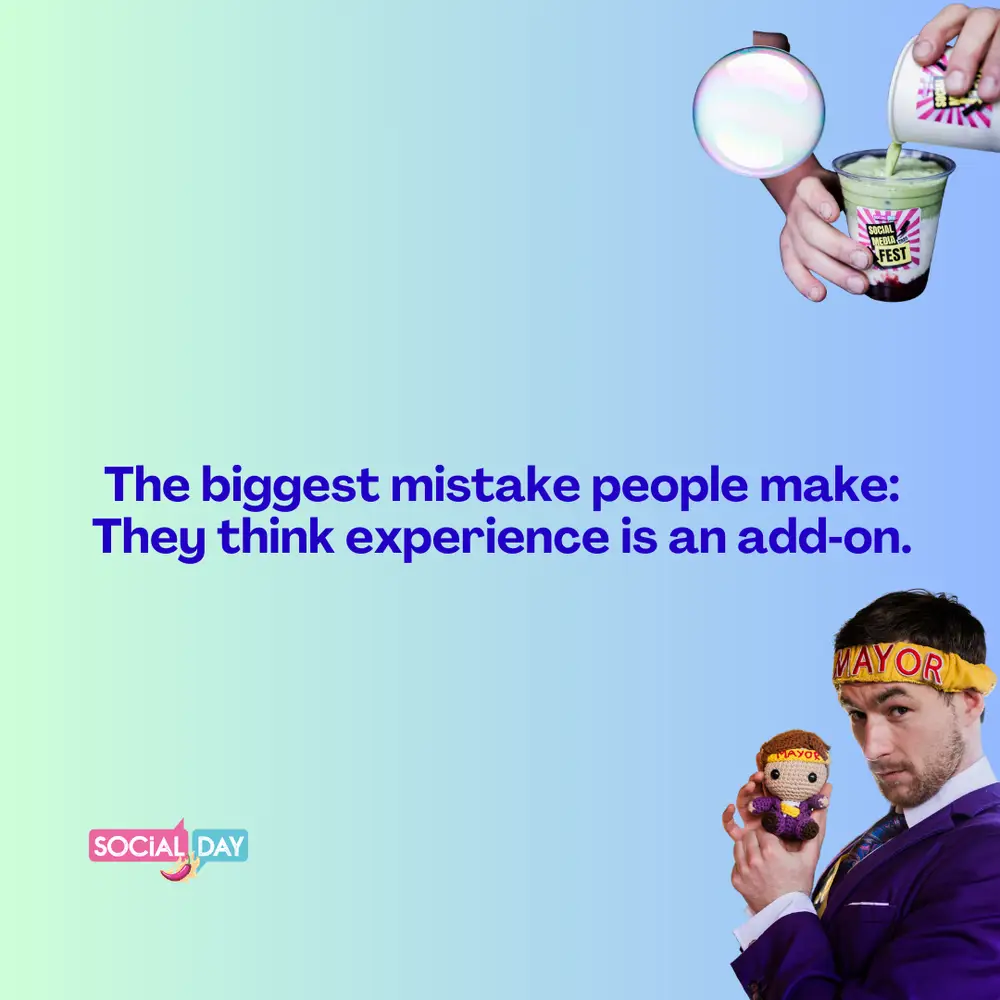
The biggest mistake I see in events and campaigns is this.
Experience is treated like a nice extra. Something you sprinkle on top once the "real work" is done.
It is not an extra.
Experience is the strategy.
When experience is an add on, you focus on:
- Agendas and timings
- Room layouts and catering
- Speaker lists and slide decks
All of that matters. But if you stop there, you end up with an event that looks fine on paper, feels flat in the room and disappears from people's minds the minute they leave.
When you treat experience as the strategy, you start with different questions:
- How do we want people to feel at each stage
- What do we want them to remember and talk about afterwards
- What story do we want them to tell, in person and on social[1]
At SocialDay, that is the starting point. Logistics serve the experience, not the other way round.
The experience timeline: before, during and after
Events do not start when people arrive.
They do not end when people leave.
Every experience has three acts:
- Before
- During
- After
If you only design the middle, you have already lost. Let us walk through each act and how we approach it.
Before: you are selling a feeling, not a schedule
Before the event, you are not selling logistics. You are selling a feeling.
Nobody gets genuinely excited by a PDF agenda. They get excited by energy, by belonging, by that sense of "something is happening and I want to be in the room".
What works before
We design intrigue before an event by:
- Teasing moments, not just schedules
- Short clips, behind the scenes, glimpses of the venue, hints at interactive elements.
- Showing the people, not only the speakers
- We highlight past attendees, community members and partners, so it feels human and accessible.
- Letting audiences feel like insiders early
- Sharing progress updates with our community, not just polished announcements.
- Making it feel like something is already happening
- So that by the time the doors open, it feels like act two, not the beginning.
This is where your social content sets expectations. If it does not look good online before it happens, people will not trust that it will feel good in real life. Your event has to live up to the story you tell.
At SocialDay, we think visually from the start. We ask "How does this look in a feed If someone only saw this one clip, would they understand the vibe and want in"
During: design moments worth capturing
During the event, your job is very simple.
Give people something worth capturing.
Do not just design for consumption. Design for participation.
Experience lives in the details
Experience moments can be:
- The room layout and how easy it is to move, bump into people and talk
- The lighting and visuals, so photos and videos look good without effort
- The drinks and food, especially anything that feels unique or unexpected
- The format, so it is not just "talk after talk" with no breathing space
- The interactions, from icebreakers to games to quiet spaces
It is the tiny things. The way a badge feels. The first impression at registration. The tone of the announcements. All of this adds up to how people feel. That is where UGC starts.
How we do it at Social Media Fest
We design moments intentionally.
Some examples:
- We have opened Tower Bridge and hosted our awards on a boat on the River Thames. Not because it looks impressive in a brochure, but because everyone remembers the feeling of being there and shares it.
- We have created our own branded matcha drinks. Small detail, big impact on how people feel and what they photograph.
- We have run the festival at immersive venues, including an escape room style space, and used passports or treasure maps to move people through different areas.
These choices are not about showing off. They are about being memorable and giving people stories to tell.
We are always thinking about belonging. How do we make everyday attendees feel like VIPs and creators, not spectators at the back of the room
When people feel special, they act like storytellers.
Elevating everyday attendees
One of the most important decisions we made at SocialDay was this. We would not reserve experiences for influencers or VIPs.
We give everyday attendees the kind of moments that are usually only offered to speakers, sponsors or "special guests".
We have seen again and again that when people feel seen, welcomed and valued:
- They are more likely to participate
- They are more likely to share
- They are more likely to come back and bring others
The content we get from this is not forced. It is not staged. It is real people having real moments and wanting to document them.
UGC is a by product, not the goal
User generated content does not appear because you begged audiences to use your hashtag.[1]
UGC is a by product of a well designed experience.
It comes from:
- Surprise
- Delight
- Emotion
- Belonging
People post when they feel something.
At Social Media Fest, some of our most shared moments have been:
- The festival style atmosphere at a B2B event
- The boat and bridge experiences
- Unexpected small details, like a thoughtful gift, a drink, a moment of recognition
We created FOMO because people shared their experiences freely. People who were not there saw it and thought "I am not missing that again".
The goal is not "more UGC". The goal is a better experience. The UGC follows.
After: where momentum really lives
Most events fail after the room empties.
Everyone is exhausted. The team collapses. The social content dries up. Then six months later, they try to start the hype again from zero.
But the "after" stage is where momentum really lives. Your next event is sold by the people who just left this one.
Extend the experience
After the event, we do not think "recap". We think "continuation".
We focus on:
- Curating the story
- Pulling together posts, quotes, photos and videos that capture the feel of the event, not just the logistics.
- Sharing reactions, not only polished photos
- Attendee posts, speaker reflections, little behind the scenes moments.
- Highlighting what it felt like to be there
- So people who missed it get a real sense of the energy and people who came relive it.
The experience should echo, not just end.
How this feeds the SocialDay community
For us, SocialDay is not a once a year event. It is an ongoing community.
We use the "after" stage to:
- Spotlight community members and their work
- Seed interest for future events and programmes
- Keep the conversation going inside and outside our channels
When people feel part of something, they do not just show up. They advocate. That is how communities are built, not just audiences.
This applies far beyond events
This way of thinking is not only for events.
It applies to:
- Programmes and courses
- Communities and memberships
- Launches and campaigns
- Brands and content series
Anywhere people choose to give their time and attention, experience matters.
We are not really in the events business. We are in the attention, memory and momentum business. Experience is how you win all three.
What moments are you leaving to chance?
The most useful question you can ask is simple.
What part of your experience are you not designing
What moments are you leaving to chance
If all your energy is going into the middle, you are missing two thirds of the journey.
Design for the story people tell afterwards, and everything you build will travel further. The experience will take care of itself.