

When we drafted the first rung of the career ladder, we described it as supporting content creation and publishing, handling basic community responses and putting together simple reporting. Livi Arnold's response to that was one of the most useful corrections, and I have quoted it back to people several times since.
"I think that what you've written down is what should be the entry level role. I think it's not always in practice what an entry level role is."
Livi is now freelance, having previously led comms and social at Women in Data®, and before that spent several years at Loughborough University. Her career is a very clear illustration of two things this research keeps running into, which are that people routinely occupy two rungs of the ladder at once from their very first job, and that the skills required to climb are ones most practitioners end up buying for themselves.
An Intern Doing Two Rungs at Once
Livi's first job title was sports marketing intern, on what she described as bare minimum money, which was around £18,500 and the minimum wage for her age at the time.
"I kind of almost skipped just being at rung one and was already doing rung one and rung two at the same time," she said. She went from being a fresh graduate to running the sport social media for Loughborough University, which she pointed out is the number one sports university in the world, and the whole of that platform management was handed to her.
The detail that I found genuinely surprising is that this was not a resourcing problem caused by being in a small organisation. Loughborough has 200 staff members across marketing and advancement.
"People often assume, oh well, you're only doing a rung one, but actually even in a big organisation we were so stretched that people were doing multiple rungs across their roles," she said, and her observation is that most of the junior people she has spoken to since are in exactly the same position.
Her title then became sports marketing and commercial activation coordinator, which is one of those long compound titles we keep encountering in this research, and which in her case meant she was still running social while also delivering the activation of the organisation's brand partnerships with sponsors including Red Bull and Maxi Muscle. She described the learning curve as very steep, going from working out how to make something look good to suddenly being responsible for the front end of hundreds of thousands of pounds worth of partnerships.
"I had no idea where to even go to learn how to do that."
The scope kept creeping outwards from there. She ended up sitting on the merchandise committee, because she had noticed that a lot of people were making decisions without understanding the audience while she was the person closest to that audience. She trained the university's sport scholars in social media best practice so they could secure their own personal sponsorships, which was not in her job specification at all. She featured in campaigns, danced as the mascot, and during the COVID lockdown she was the voice over for the gym.
There is a serious point buried in all of that, which is that scope creep of this kind is usually described as a problem, and it is, but it is also frequently how people in social media acquire commercial experience in the first place. Nobody designed that route for her.
The Design to Marketing Gap, and Who Pays to Close It
Livi came into social from a graphic design background, which she is clear puts her in an unusual position.
"Often people go into social and they say, oh, you're not a graphic designer, whereas I actually was, but I skipped out a lot of the actual marketing and that sort of principle."
So in her second and third years of working she completed her Chartered Institute of Marketing qualification, because as she put it, she knew how to visually make something look good but she was not sure she understood the principles underneath it, the consumer psychology, or why any of it was working.
This is the single most consistent finding of the entire research project. People arrive in social media able to make things look good and are then expected to progress into roles requiring commercial thinking that nobody has ever taught them. What Livi's story adds is the question of who pays for that gap to be closed, because in her case she identified it herself, and she went and fixed it herself, on her own initiative, while doing a job that had already expanded well beyond its original description.
She also raised a point about AI that follows directly from this. She had just read the Sprout Social report that landed in her inbox the day before we spoke, which sets out the gap between what marketers are prioritising and what audiences actually want. The top thing audiences said they want is human created content rather than AI content, while AI content is what UK marketers are prioritising. Her conclusion was that the more valuable use of AI sits in analysis rather than in content production, and that understanding where AI fits, and how to commercialise around it, is emphatically not a rung one skill.
Asking for Your Own Mentor
I asked Livi whether there was anybody inside the organisation who mentored her through all of this, and her answer was yes and no, which is probably the most common answer we get to that question.
Loughborough is an established organisation with a lot of training available, but as she explained it, most of that training was about the brand rather than about social specifically. The structure did not help either. University marketing and Loughborough Sport marketing operated almost like entirely separate organisations, with different departments charging each other to work together, so videography and photography would charge her team to do projects with them. She was clear that it is less like that now, but at the time it was very siloed and caused a lot of issues.
What she did next is the part worth paying attention to. She put herself forward for mentorship through the women's staff network and asked to be mentored by the director of marketing and advancement, which she described as very wishful thinking on her part, and he said yes. She had that mentoring relationship for a year, during her third year there.
The programme itself was well designed in a way I wish more were. Loughborough trains both sides of the relationship, so you are trained as a mentor and you are trained as a mentee, and the expectation is explicitly that the mentee leads, sets the agenda and asks the questions. Livi found it genuinely valuable, and bought him a gift when she left.
"That was something that I had to actively put myself forward for, rather than it being right, we've arranged this for you."
That last sentence is the whole problem in miniature. The mentoring existed, it worked, and it was only available to somebody confident enough to ask a director for it.
Why the Profession Gets Written Off as Easy
We talked about the way social media marketing gets glamorised by people presenting it as an effortless job, and about the fact that it has become a predominantly female profession.
Livi's answer had two parts. "I think anything that is predominantly a women's space is always devalued, and I think that's a wider issue to be solved in the world," she said, while also acknowledging that part of the problem is self induced by the industry's own content.
Her second point is one I had not heard put this precisely before, and it comes from having done both sides. Livi has run corporate brand social and she has run personal brand social, and she is unambiguous that the personal brand version is significantly easier, while also being the version that is most visible to everybody outside the profession. The independent influencer presenting a life of total control and easy content creation is the image the public has of this job. What that image leaves out is everything that makes the corporate version hard, which is understanding an entire tone of voice, working to business objectives, navigating red tape and reaching an audience that may be completely new to you.
Splitting Social by Audience Rather Than by Task
One of the more practical contributions Livi made is about where social should sit inside an organisation.
Her view is that the answer depends entirely on who the audiences are and how many of them there are. At Women in Data®, even with a very small team, she argued for splitting the role so that there was a social media coordinator sitting under community and another sitting under brand partnerships, which is essentially the commercial side.
Her reasoning is both operational and human. The two types of content are entirely different, and so is the way you reach the people receiving them, so the constant task switching between working out who you are talking to, which tone of voice applies and where you are reaching them wastes a significant amount of time. It also wastes internal time, because nobody is clear about who they should be talking to. She wanted the brand partnerships team to know that their main point of contact was the brand partnerships social media coordinator, rather than defaulting to the community person and wasting their time instead. The team would still support each other and pitch in, but each department would have one clear point of contact.
She made the same point about Loughborough, where the audiences included undergraduates aged eighteen to twenty one who were all physically on campus, alumni, commercial brand partners and university stakeholders, all of whom needed something completely different.
The Gap Between Output and Headcount
The thing I most want hiring managers and clients to read is what Livi said about the mismatch between how big a social operation looks from the outside and how big it actually is on the inside.
At Women in Data® the numbers were substantial, with over 100,000 followers, a sold out annual event for 3,500 people with a waiting list, more than 70 brand partners, and relationships with brands including LEGO®, Lloyds Banking Group, and Deloitte. The comms team delivering all of that was two people.
"Big brands expect a lot from you and you're only a two person team," she said, describing calls where a partner with thousands of employees would ask whether her team could just support them with something. "When you're looking at the comms team, this is it."
The team was also doing considerably more than social, covering comms, sales collateral, merchandise and live event activation, with essentially everything except email sitting with them.
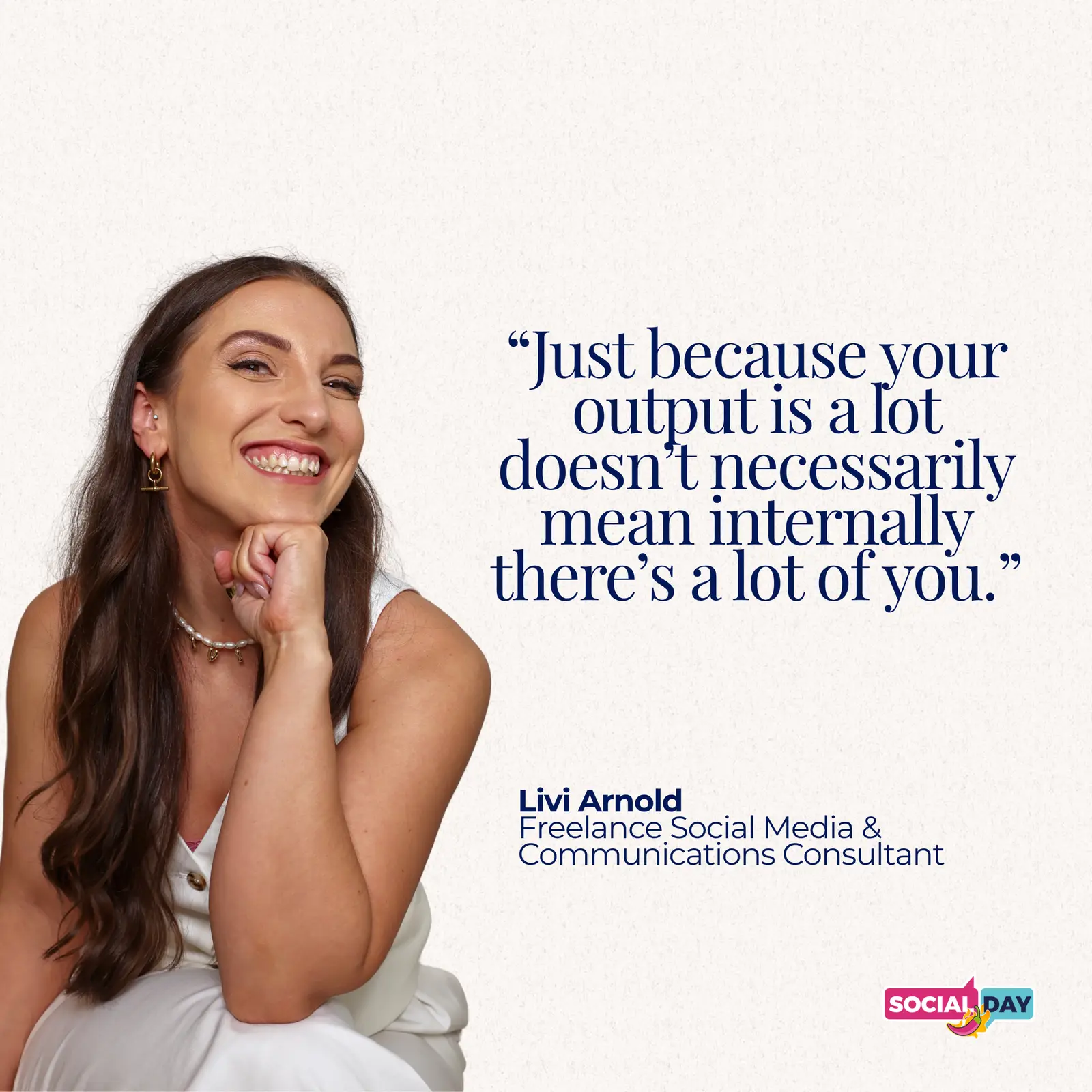
"People's perception from the outside is not the same as internally. Just because your output is a lot doesn't necessarily mean internally there's a lot of you."
She was careful to say this was not a lack of trying on the organisation's part. Hiring was happening, but it had to be balanced across the business, so comms getting a second person had to be weighed against community and events not yet having one, because growth in one team creates expectation on another.
Going Freelance Slowly, on Purpose
Livi is now freelance and is deliberately not rushing to full capacity, which is a different approach from the one most people describe to us.
Her reasoning is that she would rather work with a small number of clients now and build the infrastructure properly, so that when she does open up fully she is ready to operate at that capacity and produce work she is proud of. She has spoken to other freelancers with personal brands who went straight to fully booked and now regret it, because they never built an onboarding pack, or never set up clear parameters and boundaries around where people contact them and how work gets shared, and her sense is that it is very hard to backtrack on any of that once you are already flat out.
"If It's Your Calling, It Will Keep Calling"
I asked Livi what she would say to somebody at the start of their social media career, and her answer was about rejection.
She did not get the Loughborough internship the first time she applied. She found out later that somebody already working with the organisation had been the ideal candidate, and that the outcome had nothing to do with her.
She applied again the following year. Loughborough runs around seven internships at once across marketing, web, digital and engineering, and applicants do not get to choose which one they are placed into. She was up against a field that included somebody doing a master's in sports marketing. The process was a full day, with a panel interview, a portfolio review and two tasks, and she came out of it as their favourite candidate across the board, to the point that departments argued over which of them got her, and she was given her choice of placement instead of being assigned one. The internship was designed as a rolling one year post that went to a new person each year, and they offered her a permanent role within two or three months.
"I could have easily gone, right, well, I failed at that, I just won't apply again, it's not for me," she said. "But I always think, if it's your calling, it will keep calling. If you want it, just keep going, and if it's meant to be, it will be. Don't give up on the first no. It might just not be in your control at that time."
What This Means for You
If you're early in your career: Livi's story is a useful corrective to the idea that you have to wait to be given things. The mentoring she got, the qualification that closed her commercial skills gap and the job itself all came from her asking a second time, or asking somebody senior directly, or paying for the training herself. That should not be necessary, and this research exists partly to argue that it should not be, but until the profession has proper structures in place it is worth knowing that the people who progress are very often the ones who asked.
If you're a hiring manager or a leader: two things from this conversation are worth acting on immediately. The first is that a large organisation is not automatically a well resourced one, and your entry level people may be carrying two rungs of work while being paid and developed for one, so it is worth actually checking rather than assuming. The second is that if you are running mentoring, look at who is using it, because a scheme that only reaches the people confident enough to approach a director is not a development programme, it is a filter.
We're building the most comprehensive piece of research ever done on the social media profession, and conversations like this one are exactly why this project matters. If you work in social media, at any level and in any kind of organisation, I want your voice in the data too.
Fill in the survey: socialday.live/career-survey
It takes less than five minutes and every response counts.
Livi Arnold is a freelance social media and communications consultant, and was previously Communications Director at Women in Data®. This article is based on an interview conducted on 30 June 2026 as part of SocialDay's Social Media Career Ladder research. All quotes have been reviewed and approved by the contributor prior to publication.