
What's actually happening
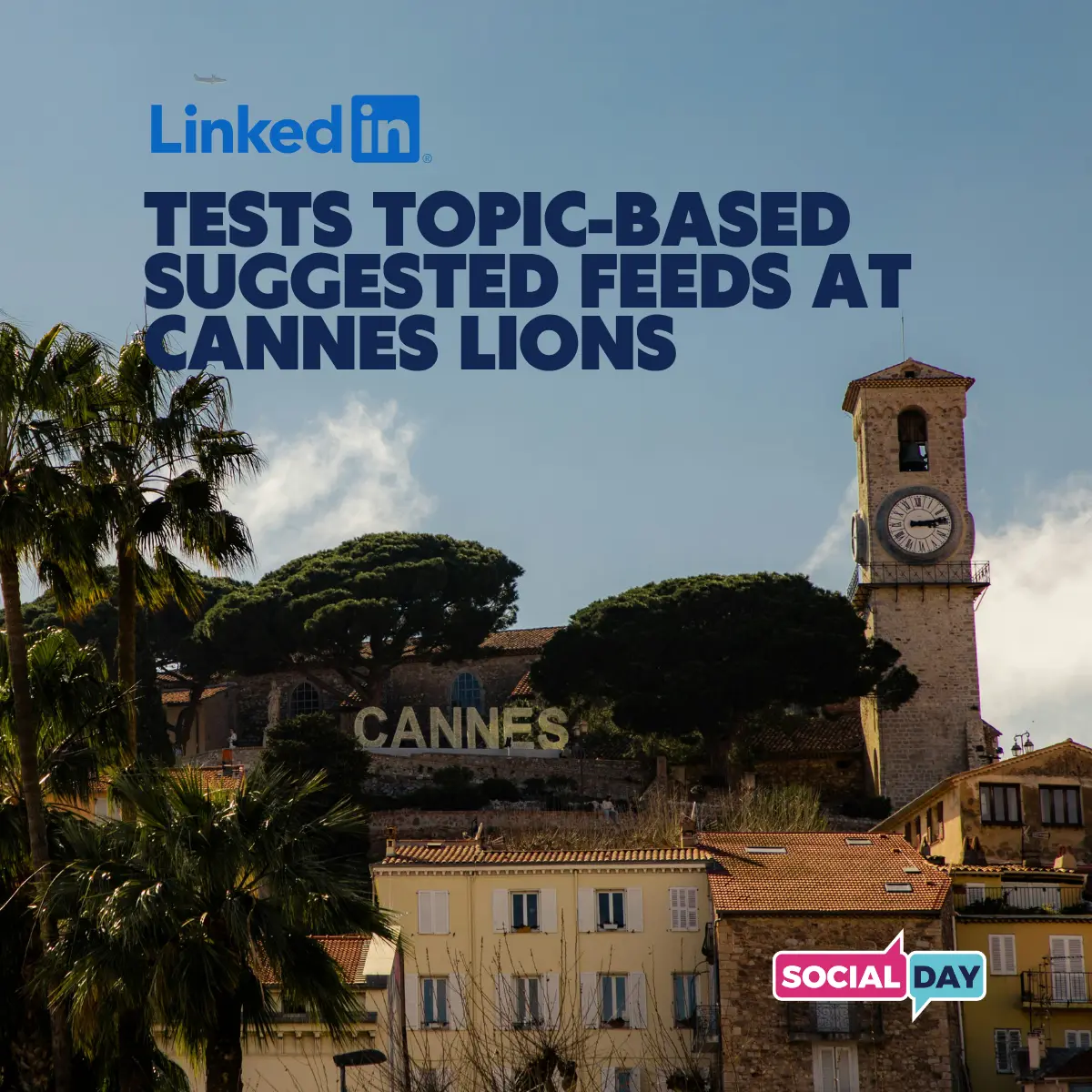
LinkedIn is running a live test of topic-based suggested feeds this week, with a select group of users attending the Cannes Lions festival in the audience. The feature sits alongside the main news feed rather than replacing it. Users see additional feed streams curated around the topics they engage with in the app, or trending professional news stories of broader relevance.
The feature was surfaced publicly by Julia Cabral Flavin, LinkedIn's Senior Director of Product Marketing, who shared an example of the interface and confirmed the test is live. Feedback from the Cannes cohort has been positive so far, which Cabral Flavin suggested could point toward a broader rollout.
No timeline for wider deployment has been announced.
Why LinkedIn picked Cannes to test this
Choosing Cannes Lions as the testing ground wasn't arbitrary. That audience skews heavily toward marketing and advertising professionals: exactly the kind of high-engagement LinkedIn users who will surface real signal on whether topic feeds add meaningful value. If the feature holds up there, it holds up anywhere.
It's also worth noting this is LinkedIn's second attempt at alternative feed formats. A similar test ran last year but quietly faded, with no notable user response and no public announcement of expansion. This iteration takes a different approach, making feeds explicitly topic-based and personalised to engagement history rather than offering generic alternatives to the main stream.
The algorithm context that makes this significant
The suggested feeds test doesn't exist in isolation. In March 2026, LinkedIn published a detailed engineering blog post outlining a fundamental rebuild of its feed recommendation system, moving from a fragmented set of retrieval pipelines to a unified, LLM-powered architecture.
The old system relied on keyword matching and collaborative filtering. The new one uses LLM-generated embeddings to understand what posts are actually about, and matches that semantic content to a member's evolving professional interests, not just their historical engagement data. LinkedIn replaced several separate discovery systems with a single LLM-based retrieval model, and the ranking layer now uses a transformer-based sequential model that analyses patterns across a user's past interactions rather than evaluating each post independently.
The practical upshot: posts can now travel to professionals who have never followed the author, never searched for the topic, and have no direct connection to the poster, as long as the LLM detects a semantic match between the content and the reader's professional interest signals.
LinkedIn said the new system is designed to give creators more opportunities to reach interested audiences. The suggested feeds test is the natural next step in that direction: a dedicated surface for exactly that kind of out-of-network discovery.
The content volume problem LinkedIn is solving
The scale of what LinkedIn is dealing with makes the logic clear. LinkedIn CEO Daniel Shapero reported in May that posts on the platform increased 14% in Q1 2026, while paid video grew nearly 30% year-over-year. More content being created means more content that could be valuable to someone, but the main feed, filtered by network and interaction history, can only surface so much at once.
When content volume grows faster than network density, the risk isn't just that users miss things. It's that creators posting genuinely expert niche content to small networks are structurally disadvantaged, not because their content isn't good, but because the main feed's distribution logic doesn't route it far enough. Topic-based suggested feeds are LinkedIn's answer to that routing problem.
What this means for B2B social teams on Monday
Network size matters less than it used to. The LLM algorithm already routes posts beyond direct connections when topical relevance is strong. Suggested feeds would formalise that dynamic into a dedicated surface. A 500-follower subject-matter expert posting genuinely sharp niche content could reach the same professional audience as a brand page with 50,000 followers posting broad updates.
Company pages are already losing the organic reach battle. This shift compounds an existing structural problem. According to Whitehat SEO's analysis of industry benchmarks, organic company page posts represent only around 2% of what appears in LinkedIn users' feeds, while personal profiles generate five times more engagement than company pages. The algorithm's topic matching logic is built around professional identity signals (career history, skills, expertise) that company pages simply don't carry in the same way a person does. A brand page posting a case study announcement gives the LLM very little to match against a reader's professional profile.
Topical consistency is now a distribution strategy, not just a brand preference. The LLM-based retrieval system builds a semantic model of what an account is about across its posting history. Accounts that post coherently around a specific professional domain will have a clearer topical fingerprint for the algorithm to match against suggested feed audiences. Accounts that post broadly across unrelated topics will be harder to route.
Depth beats breadth, and the signals have changed. The March 2026 algorithm update made dwell time the dominant ranking signal. A post someone reads for thirty seconds outperforms one that collects fifty quick reactions. Document carousels, which force sustained attention through swiping, are currently the highest-engagement format on the platform. Saves are the highest-intent signal the algorithm can measure. Comments carry significantly more weight than likes. Engagement pods and bait-based tactics are actively suppressed.
The golden hour still matters. The algorithm evaluates posts during the first hour after publication. Strong early engagement triggers expanded distribution into second and third-degree connections. If a suggested feeds rollout follows, that same early-signal logic will likely govern which posts get routed into topic feeds.
The honest caveat
This is still a limited test with no confirmed rollout date. LinkedIn's previous attempt at alternative feeds went nowhere. The Cannes cohort is an unusually engaged and professionally homogeneous group, which may produce more positive signal than a general user base would. The feature's real-world performance at scale, and what ranking logic governs which posts appear in suggested feeds, remains unknown.
What's not in doubt is the direction. LinkedIn has rebuilt its algorithm to prioritise topical relevance and out-of-network reach, and this test is the logical product expression of that infrastructure. B2B social teams that treat LinkedIn as a broadcast channel for company page announcements are running a strategy that was already underperforming. Suggested feeds would make that gap wider.