
The activation nobody else could have built
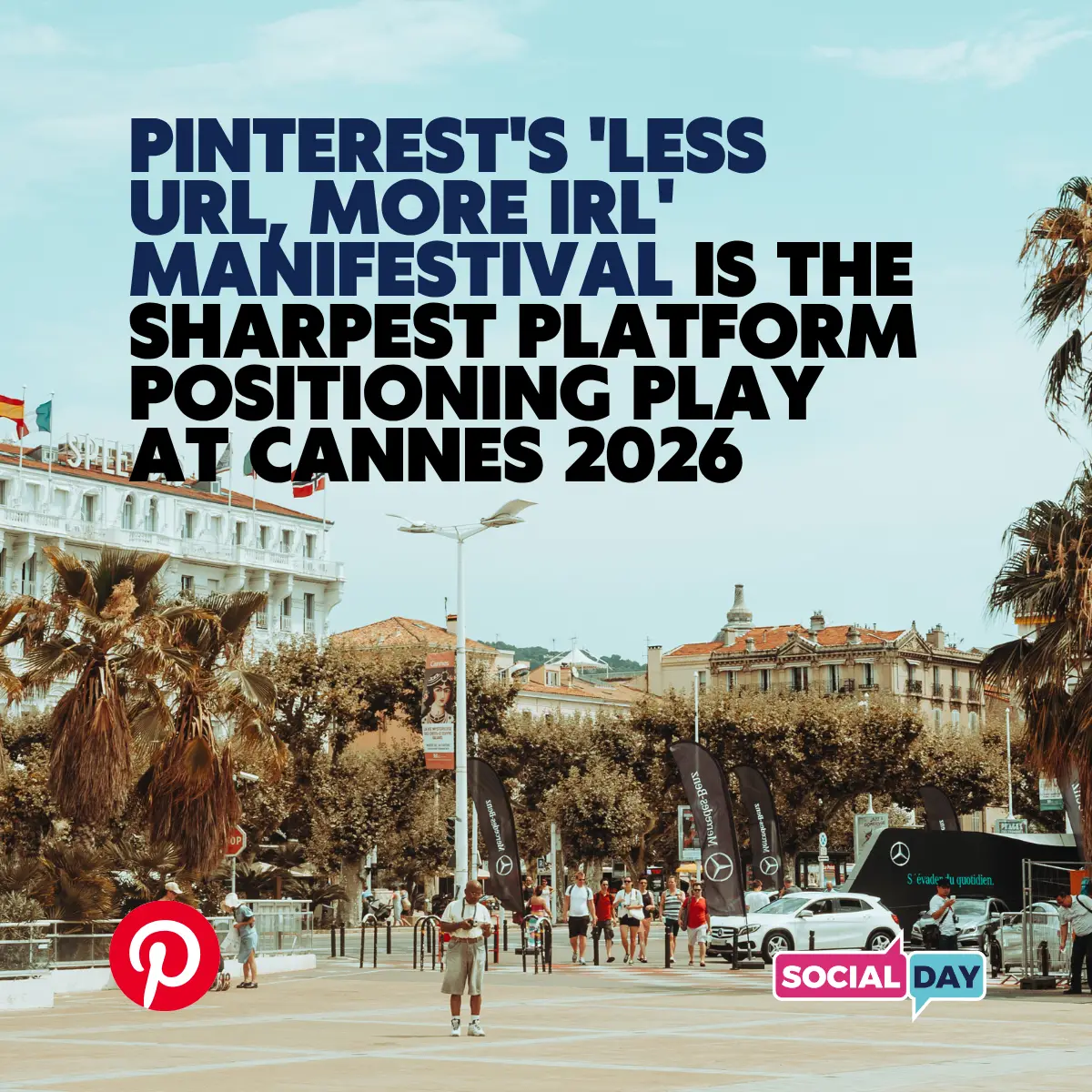
Walk onto the Croisette at Cannes Lions this week and most of what greets you is familiar: branded beach clubs, panel stages, QR codes asking you to follow an account. Pinterest's Manifestival, running at the Carlton Beach Club from 22 to 26 June, is doing something structurally different.
There is no panel stage. There is no branded selfie wall. There is no QR code asking you to follow an account. Instead, upon arrival, guests receive a Pinterest-branded phone sticker with the phrase "Less URL, More IRL."
What follows from that sticker is the point. The Manifestival is where attendees can interact with the trends, aesthetics and ideas shaping culture, putting phones aside, taking a cue from Gen Z and getting creative through IRL experiences designed to spark discovery and turn inspiration into something tangible and real.
The specific activations deliver on that positioning without flinching. There is a tattoo parlour with a line that snakes around the corner, people waiting in the Cannes heat to leave with something permanent that started as inspiration on a screen. Guests send handwritten postcards inspired by Gen Z's rising love for analog letters, in partnership with the French postal service, La Poste Française and the Cannes Lions Festival for Creativity. Sephora is partnering with Pinterest to bring the Pinterest Palette: Bleach Club to life, with attendees exploring bold, personal approaches to colour and styling, from hair to clothing, turning this year's Pinterest Palette colours into wearable self-expression. In partnership with Adobe, a Visual Search Studio invites guests to visually discover their personal aesthetic by using handheld scanners to capture what they love.
Every activation ends with you taking something physical away. That's not accidental stagecraft. It's the argument.
This is a fourth-year strategy, not a stunt
It's worth being precise about what Pinterest has actually built here, because the casual read is "nice experiential marketing." The more accurate read is a multi-year brand reframing exercise that has now won enough external validation to be called a strategy.
The Manifestival is described by Cannes Lions' own partner pages as "BizBash's #1 Cannes Lions activation in 2025." The Pinterest Manifestival previously exceeded all goals across attendees, client meetings, and global press stories, and received the highest net promoter score across all brand activations at the Cannes Lions festival. Adweek called it "the most interactive activation on the Croisette."
This is the fourth year Pinterest has run the Manifestival. That repetition is itself significant. A one-off experiential stunt is a tactic. Four consecutive years of the same coherent idea, refined and expanded each time, is positioning.
The strategic tension it's exploiting
The insight Pinterest is working from is sharper than it first appears. Most platforms at Cannes are trying to prove they deserve more of your brand's media budget by demonstrating reach, engagement, or AI capability. Pinterest is doing something different: it's demonstrating a reason to exist that no other platform can credibly claim.
Pinterest's own framing is direct: "While other platforms can sell the illusion of living, Pinterest helps people create a life they actually want to live." That's a deliberate shot at scroll-driven, performance-optimised social media, and it lands because it reflects something real about how Pinterest users actually behave.
Pinterest has 631 million monthly active users as of Q1 2026, 5 billion monthly searches, and 2.2x higher purchase intent than any other social platform. Critically, on Instagram or TikTok, the algorithm decides what to show. On Pinterest, the user has already decided what they want; the algorithm's job is just to surface the best version. That structural difference matters enormously for advertisers, and the Manifestival is Pinterest's most theatrical way of making the case for it.
The "Less URL, More IRL" approach has become a key differentiator as the platform looks to separate itself from other social media apps. The genius of using Cannes to make that argument is the context: you're saying it in a room full of the people who buy media. And you're not saying it in a deck. You're making them feel it.
The business underneath the beach chairs
The Manifestival doesn't exist in isolation. It's the consumer-facing tip of a platform that is, simultaneously, making a serious push into AI-powered performance advertising.
Ahead of Cannes Lions this year, Pinterest introduced new AI-powered tools including Business Assistant, Pinterest Model Context Protocol (MCP), and new Pinterest Performance+ creative capabilities, alongside Ask Pinterest, a limited-access app to experiment with the next generation of AI-powered shopping experiences.
Pinterest's Chief Business Officer Lee Brown put the commercial ambition plainly: "The future of discovery won't be driven by keywords alone. It will be shaped by context, taste, and trusted recommendations."
Pinterest Performance+, the platform's AI-powered performance ad suite, now accounts for approximately 30% of lower-funnel revenue, up from near-zero at general availability roughly a year ago. Q1 2026 revenue reached $1,008 million, up 18% year over year, with global monthly active users at an all-time high of 631 million, up 11%.
So Pinterest is simultaneously running a brand campaign built around digital detox and an ad product roadmap built around AI and conversion. Those two things are not contradictory. The brand platform drives the user behaviour (intent-led searching, real-world action) that makes the ad product defensible. The Manifestival is, in effect, a live demonstration of the media proposition.
The Gen Z angle is not decoration
Pinterest keeps invoking Gen Z at the Manifestival, and it's not just demographic window dressing. Gen Z now makes up 42% of all global Pinterest users, the platform's fastest-growing segment. The Manifestival was explicitly inspired by the insight that Gen Z call Pinterest their "Manifestation App."
The "Less URL, More IRL" positioning resonates specifically with Gen Z because it mirrors a documented behavioural shift. The Pen Pals postcard station showcases Pinterest Predicts' "Pen Pals" trend, inspired by Gen Z's rising love for analogue letters. This is a generation that grew up entirely online and is now actively seeking offline texture. Pinterest's positioning threads that needle: the platform is where you plan the offline life you want, not where you perform a life for an audience.
In a marketing world obsessed with engagement metrics, Pinterest is betting that helping people live better offline is the ultimate brand win.
What brands can actually steal from this
The transferable principle here is not "do an experiential activation at Cannes." Most brands don't have Pinterest's budget or access. The principle is more specific: your platform positioning is most powerful when it resolves a tension your audience already feels, and when you can demonstrate it rather than just claim it.
Every social platform right now is grappling with a version of the same anxiety: that the product creates compulsion rather than value, that users feel worse after using it, not better. Pinterest has chosen to address that anxiety head-on rather than paper over it. The sticker that says "Less URL, More IRL" only works as brand positioning because it names something real. And the Manifestival only works as a demonstration because every single element of it physically enacts the promise.
For brand marketers specifically, there are three practical implications:
1. Your brand's tension is an asset, not a liability. Pinterest is a digital platform openly telling people to spend less time on digital platforms. That apparent contradiction is what makes the positioning memorable and credible. What is the honest tension at the heart of your brand, and are you leaning into it or hiding from it?
2. Demonstration beats declaration at the point of trust. The Manifestival doesn't ask CMOs to believe that Pinterest drives real-world action. It makes them do a real-world action. The medium is the message, in the most literal possible way. When you're making a claim about what your brand enables people to do, the most persuasive version of that argument is always live and physical.
3. Consistency of idea compounds over time. Pinterest has run this concept four years in a row. The brand idea has accumulated meaning and credibility precisely because it hasn't changed. In a landscape where brands refresh their positioning annually, the durability of a single coherent idea becomes its own differentiator.
The Manifestival runs until Friday. The lesson it contains runs rather longer than that.