

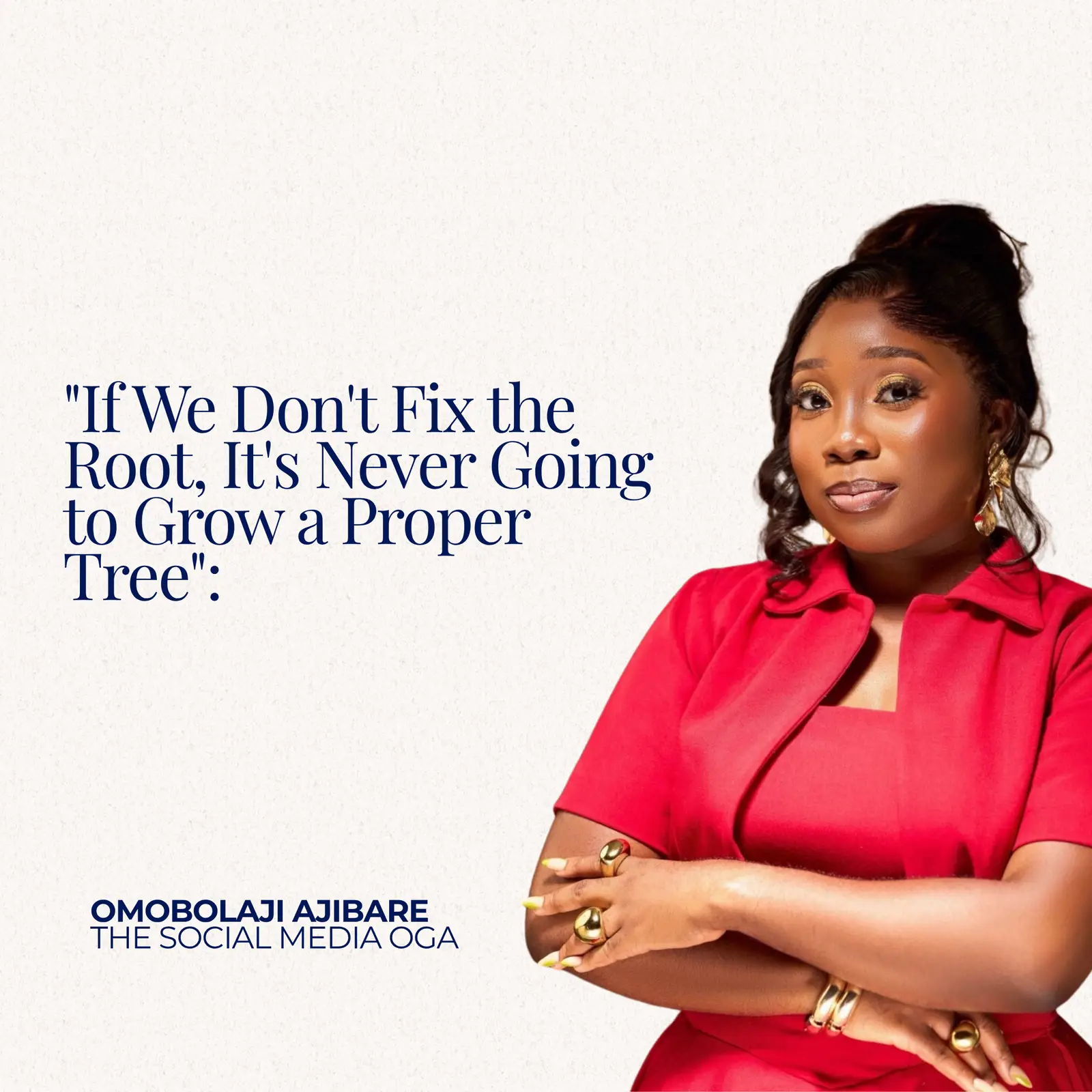
Every so often in this research somebody says something that reorganises how I think about the whole problem. Omobolaji Ajibare, who many people in the industry know as The Social Media Oga, did that twice in half an hour, and she did it while eating her lunch between client calls.
Omobolaji has spent her entire corporate career in social media. She studied computer science, started freelancing while she was still studying, and her first job out of university was as a social media manager. Since then she has worked corporate, freelance and contract, and she runs a community for social media professionals, which gives her a view across the industry that very few individual practitioners get.
She is also, by her own description, a numbers person, which shapes everything she had to say.
Sixty Titles for Three Jobs
We started where we always start, with the first rung of the ladder and the roles that sit on it, and Omobolaji's answer cut through the confusion faster than anything else I have heard.
"We've made it look like it's 60 different roles, when in reality most of those different names are the same responsibility," she said. A marketing intern, a social media assistant and a content assistant are, in her view, doing the same job, and the industry has simply given that one job dozens of names.
Then she drew the distinction that I think should sit at the centre of our framework.
"The role of the social media assistant is, I help make the content happen. You're not the one deciding what the content should be."
That single sentence separates execution from ownership more cleanly than any job description I have read during this project, and it explains why the salary conversation is such a mess. If an organisation cannot tell the difference between somebody who makes content happen and somebody who decides what the content should be, it has no basis on which to price either of them.
Her diagnosis of why we ended up here is structural. "There's no particular body to guide and say this is what it should be," she told me, and without that, the titles proliferate while the underlying jobs stay the same. Her verdict on the current state of them is blunt. "The titles are actually useless."
Why the Salary Stays Low
Omobolaji has a clear explanation for why social media salaries remain stubbornly low, and it is not the one I expected.
"The salary is still quite low, especially in the UK, because the role is still being priced as a junior role," she said. In most companies, social is still understood as posting, replying to comments and designing, and if that is what an organisation believes the job is, then it will pay what it pays for an admin role. The pay is not lagging behind the perception. The pay is an accurate expression of the perception.
The second half of her argument is about supply, and it is uncomfortable but worth sitting with. There are, she pointed out, an enormous number of people offering pure execution at low cost, whether that is offering to post for you, design something for you or just manage your page. The volume of that noise leads companies to a reasonable if wrong conclusion.
"Companies are asking themselves, okay, why should we pay this person more? Anyone can do this, right?"
She sees the consequence of that in her own inbox. The most recent brand to approach her about content creation offered a budget of $150 for three or four videos, and her read on how that happens is that a junior social media person inside the brand either did not know enough to push back or was not in a position where pushing back was possible.
Omobolaji also went to war on this point in public. She got into an argument on X that went viral, after virtual assistants insisted that social media management sits underneath virtual assistance. It spread to Instagram and to LinkedIn and ran for days, and she ended up writing an entire newsletter breaking down what virtual assistance actually is. I mention it because it illustrates something that this research has consistently found, which is that a significant part of the senior practitioner's job in this industry is defending the definition of the work itself.
"You Cannot Learn On the Job"
The strongest position Omobolaji took, and the one I expect will generate the most disagreement, is about training.
"If you call yourself a social media manager, you need to get proper training. You cannot learn on the job. You can't go to a doctor that is learning on the job."
Her reasoning comes from her own experience of doing it the other way round. She had been working in social for years before she took her master's in digital marketing and analytics, and she describes that as the point where she became a numbers person and understood that the data informs the strategy before anybody starts making content look good.
She is equally direct about where that training does not come from.
"You're not going to learn anything from Google Digital Garage. You're not going to learn anything from HubSpot's free course. There's a reason the course is free, just to give you a certification. You're not going to learn the main things if you don't actually pay for the knowledge."
She has been challenged on this, including by somebody who complained that her YouTube videos were surface level. Her answer was that YouTube is where free knowledge lives, and that she paid to be trained and paid to learn how to build a strategy, so anybody who wants that from her can pay for it too.
Underneath the bluntness there is a serious industry point, which is about the separation of two jobs that keep getting treated as one. Making content and marketing through social media are different skill sets, and Omobolaji believes the profession's job is to say so clearly.
"Just because you can manage your own brand, just because you can grow your own page, doesn't mean you can do it for a brand or for a business or for another person."
She sees the consequences of that blurring when she looks at how people apply for jobs. Candidates send a before and after of an Instagram page as a portfolio, or copy somebody's UGC portfolio from TikTok, and submit it for a social media executive role. Her conclusion is not that those candidates are chancers. It is that nobody ever showed them what a portfolio for this job is supposed to look like.
"There's a lot of training for AI. There's a lot of training for people that want to become programmers, for people that want to become engineers. Why isn't there one for people that want to become social media managers?"
Running on Vibes
When we got on to why the role gets treated the way it does internally, Omobolaji gave me a phrase I have quoted several times since.
"Even though they feel like they have structure, they really don't have clear expectations, and they run on vibes."
What follows from running on vibes is predictable. "We end up doing the job of three to five people, because the role itself is not respected internally." Brands join trends after the trend has passed, because everything has to move through stages of approval. There is no mentorship, no clear direction and no proper onboarding when people are hired into these roles.
Then she said something that has stayed with me.
"Most of us actually learn this job out of survival. If this doesn't work for us, we don't have a backup plan."
That is a very different picture from the glamorised one, and it deserves to be set directly against it. Her view of the glamorisation is that it took hold particularly during COVID, when a lot of people who were posing as social media managers turned the job into an aesthetic, and she is scathing about the resulting content. "Get ready with me, a day in my life as a social media manager, and then you're going to the gym. I really don't see you doing anything on your laptop." She has since had big brands come to her for consultancy after discovering that the social media manager they hired had bought followers for the account.
What Happens When They Hire From Outside
One of the reasons Omobolaji speaks with such certainty about internal devaluation is that she experienced the sharpest version of it in her very first job.
She was the social media manager. Rather than promote her, the company hired somebody from outside and gave him the title of digital marketing manager. Her account is that she was doing the digital marketing manager job and the social media manager job at the same time, and that it was only after she left the company that they realised one person had been covering two roles.
She connects that decision to something wider that she is currently tracking, which is the way marketing titles are being reframed. Her observation is that marketing was pushed towards women when it was assumed to be an easy job, and that now the work has been shown to be harder than that assumption allowed, the titles are being rewritten to appeal to men, with better pay attached. She pointed to roles now being advertised as social media engineering, and to pay levels that she says nobody would offer a social media manager or a social media strategist doing comparable work.
"That's why I will forever remain a feminist."
The Root and the Tree
I asked Omobolaji whether we should be defining a single ladder or a ladder with offshoots, and she was clear that the offshoots version is the right one, with the people who have actually built careers in this industry recognised as the pioneers of those routes and then properly involved in building the training that follows.
She also spoke about her own version of an offshoot, because after a long time as a social media manager she reached the point of not knowing what came next. What she did was move into mentoring social media managers, then into content creation, and then into building out creator academy work, drawing on her experience as an ambassador for Grammarly, Adobe and CapCut to help brands design their own ambassador and creator programmes.
Her reason for wanting this fixed is not abstract. "We are overworked and we are underpaid, and then there's no promotion structure," she said, adding that she has been tempted to leave the industry altogether on the basis that she holds a computer science degree and could earn more elsewhere. That is what the profession stands to lose when the ladder does not exist.
I asked her what she wanted to leave us with, and she said, "When it comes to the career ladder, we need to start with the root. The root of social media management and social media marketing is all muddled up, and it's not growing a proper tree. If we don't fix the root, we're just going to keep having weeds stunting our growth, and the pay is not going to rise."
The weeds she wants pulled up are specific ones, which are the beliefs that this is a job meant for women, that it is easy, and that it is only about posting and aesthetics.
"Let's just fix the root, and the career ladder will form itself, and it will grow into a very beautiful tree at the end of the day."
What This Means for You
If you're a practitioner: Omobolaji's distinction between helping the content happen and deciding what the content should be is the most useful self assessment tool to come out of this research so far. Work out honestly which of those two jobs you are currently doing, because that tells you both what you should be paid now and what you need to learn next. Her position on paying for proper training will not suit everyone's budget, and it is fair to point out that a profession which forces its own practitioners to self fund the skills their employers require has a structural problem rather than an individual one, but her underlying point stands, which is that free certification courses are not the same thing as being taught.
If you're a hiring manager or a leader: if you cannot articulate what social media is supposed to do for your business, you will hire one junior person, ask them to cover everything from strategy to reporting, and then hold them responsible when the results do not come. That sequence came up in this interview and in almost every other one. The fix begins before the job advert, with deciding what the function is actually for, because the salary you offer is a direct expression of what you believe the job is.
We're building the most comprehensive piece of research ever done on the social media profession, and conversations like this one are exactly why this project matters. If you work in social media, at any level and in any kind of organisation, I want your voice in the data too.
Fill in the survey: socialday.live/career-survey
It takes less than five minutes and every response counts.
Omobolaji Ajibare is a social media consultant, educator and community founder, known online as The Social Media Oga. This article is based on an interview conducted on 15 April 2026 as part of SocialDay's Social Media Career Ladder research. All quotes have been reviewed and approved by the contributor prior to publication.