
Within hours of the closing remarks on Wednesday, LinkedIn was alive with it. Posts, reflections, photo dumps, threads of takeaways, and the particular energy that only follows an event when people leave with more than they expected to carry home. By Thursday morning, #SMF26 had pulled together a stream of practitioner voices unlike any other UK marketing event this year.
The verdict was consistent: "Social Media Fest was amazing." The vibe across both days was described as "unreal" and the energy held from the pre-event welcome drinks on Monday through to the final networking session on Wednesday evening.
This was not the same event as five years ago. And that is the point.
The Room, The People, The Feeling
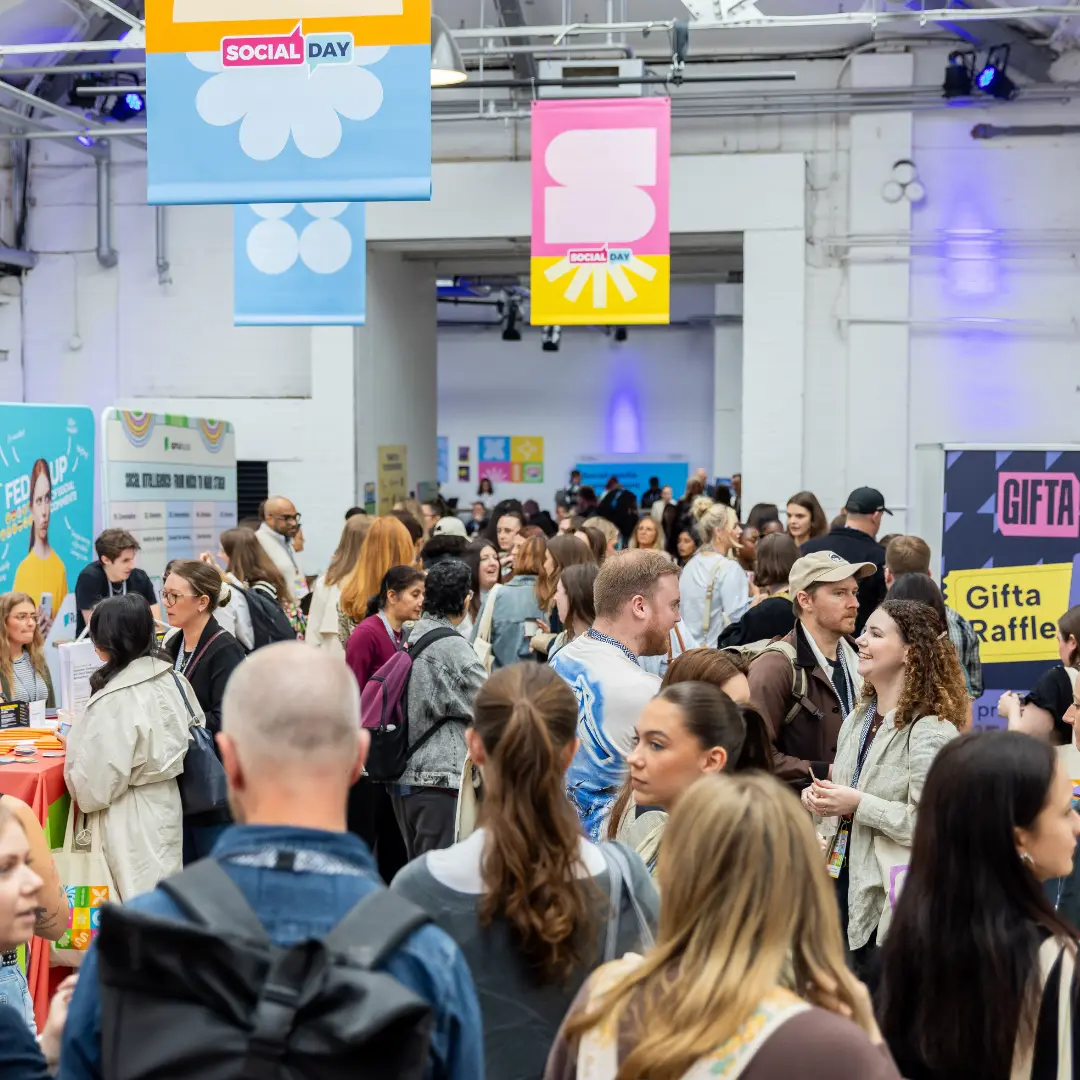
Protein Studios gave the festival exactly the right energy. Raw, creative, Shoreditch-shaped, it suited an event that has always resisted the conference centre aesthetic. With 600+ mid and senior marketers filling multiple stages and every corridor, the physicality of the space mattered. These were not people who had sat through a day of passive keynotes. They had been active in rooms, asking questions, comparing notes, reconnecting with people they follow on LinkedIn and finally meeting in person.
Sam Hughes, Reddit's Head of Industry, had set the tone before he even got on stage. "Excited to be speaking at SocialDay Social Media Fest 2026 this week. The festival kicks off tomorrow and runs across two days at Protein Studios in Shoreditch, bringing together a brilliant mix of marketers, brands, and social leaders," he wrote on LinkedIn two days before the event. That energy, the anticipation, carried into the days themselves.
Fiona Darley, MC across both days, was already on her way to Shoreditch before the doors opened: "SO WHO IS COMING TO SocialDay TOMORROW OR WEDNESDAY?! I'm in a London cab on my way to Protein Studios, Shoreditch, to get the walk around." That pre-event excitement proved entirely justified.
For Ellie McGuigan, speaking on the paid social panel for Cancer Research UK, the experience of being on stage was its own kind of milestone. "Loved every minute speaking at SocialDay yesterday. I remember watching from the side lines last year, so to attend and speak on stage this year has been a real privilege. Attending with my lovely colleague Kristy, discussing takeaways between talks and catching up with people I've met through LinkedIn and events made everything that more special." It is a moment that reflects something fundamental about how SocialDay works: the audience becomes the speakers, the speakers become the community, and the community becomes the reason people return.
Hannah Campbell, who hosted the Day Two influence panel, had already flagged the significance of the room ahead of the event: "This May, I'll be joining 500+ social media marketers, brand teams and creators in London for two days focused entirely on what's really happening in social right now."
Edward James, posting on Day One with the hashtag #socialday #smf26, described it as "such a great" event as the sessions were still running, the kind of live reaction that tells you more than any post-event survey.
And one of the clearest expressions of what Social Media Fest means to this community came from an Instagram post on the evening of Day Two: "That's a wrap on 2 days of @socialday_s fest! The vibe across both days was unreal." Another attendee's post dump captured it in a single line: "Social Media Fest was amazing."
The Movement Everyone Was Describing
The post-event noise on LinkedIn wasn't just warm it was specific. Practitioners were sharing what they'd actually taken away, the ideas they were already planning to apply, the sessions that had reframed something they thought they understood.
The through-line across nearly all of them was the same thing the programme had been built around: the job of a social media professional in 2026 is not what it was. As SocialDay's own community research has found, around 58% of Social Media Fest 2026 attendees carry a job title that nobody else in the room shares a data point that captures both the fragmentation and the richness of a discipline that has expanded beyond any single definition. The sessions at Protein Studios reflected that. This was an event for people who are doing something genuinely new.
Lucy Hall, SocialDay's founder, set the terms clearly in an April post that cut through the noise of the run-up: "SocialDay Social Media Fest isn't a conference where you sit through panels about things you could've googled. Every session is built around real practitioners from brands, charities and agencies come and share their expertise. In fact most speakers have been attendees, so there's a real community feel." And then, articulating the reason it matters: "We have CPD accreditation this year as always, Independently reviewed. That matters to me because it means when you spend two days with us, it counts."
It counts. That is the phrase that stayed.
What Was in the Room
The festival ran across three simultaneous streams the Headline Stage, the Spotlight Stage, and a Breakout Space, with a Meet the Experts Café running across both mornings. The sessions that generated the most LinkedIn traction in the hours after the event fell into a clear pattern: they were the ones that told practitioners something true about how the industry has changed, rather than something reassuring about how it hasn't.
Search, Intelligence, and the Signals Nobody Was Reading
Ray Saddiq of Rise at Seven opened Day One by making the case that the most powerful insights in modern marketing are hiding in plain sight: not in what people post publicly, but in what they search privately. Every query on Google, YouTube, TikTok, and ChatGPT reveals demand at a granular level that most social strategies are still ignoring. The session reframed social media professionals as intelligence analysts rather than content producers and that reframing set the register for two days of unusually honest conversation.
Curtis Midkiff of Sprout Social built the same argument on Day Two: "Are you filling a feed, or are you fuelling a business?" His Social Glow Up session made the case that most brands are making decisions from isolated data fragments, missing the market intelligence that social could be providing. The role of the social practitioner, he argued, is no longer about channel management. It is about providing strategic infrastructure.
The Comments Section Is the Strategy Nobody Has
James Urquhart of Rupert delivered one of the most-shared sessions of the festival: "The Most Ignored Channel in Social Media." The thesis was simple and stinging: brands spend thousands crafting the perfect post and then leave the comments as an afterthought. The comments section is where reputations are built, defended, and destroyed. It is where customers make their real-time judgements about whether a brand is worth anything. And yet most teams still treat it as reactive customer service rather than strategic brand management.
Several LinkedIn posts in the aftermath referenced this session specifically the recognition that the most valuable real estate in social has been systematically underinvested.
B2B Got the Stage It Deserves
One of the clearest evolutions in the 2026 programme was the dedicated B2B Breakout Space a recognition that B2B social has its own distinct pressures and its own distinct maturity. Luan Wise and Andy Lambert opened the space on Day Two with a session that refused to be polite about where the industry stands: five macro shifts are rewriting the rules of B2B social, and most teams are still measuring the wrong things.
Stef Lait of Sphere of Influence, who was "great to be part of an event built for the people actually doing the work" made the uncomfortable case about Reddit: that anonymous peer communities are now shaping B2B purchasing decisions in ways that no LinkedIn campaign can replicate. Influence in B2B is increasingly built through participation and expertise, not impressions.
The LinkedIn isn't Broken panel, hosted by Xandrina Allday who had been "SO excited" to be back as a host brought together practitioners from RS Group, Howden, and Monzo for the kind of candid strategy conversation that the B2B community has been waiting for. The consensus: the platform is not the problem. The strategy usually is.
The Honest Creator Conversation
The influence and creator economy sessions on Day Two stood out for the same reason as the paid social panel on Day One: they resisted the temptation to be optimistic at the expense of being useful. The Business of Influence panel hosted by Hannah Campbell with representatives from Adobe, Leo UK, and Plantmade asked the question most influencer marketing sessions avoid: is this genuinely working, and how do you know?
Tubular Labs' Zaklina Folga brought social video data to bear on the creator partnership question: cross-category, culture-driven collaborations consistently outperform brand-safe pairings, and audience overlap matters far more than brand alignment. The insight for practitioners: the data now exists to justify unexpected choices to risk-averse decision-makers.
When Brands Get It Wrong
The inclusivity panel: When Brands Get It Wrong: Inclusivity, Backlash and Social Trust was a standing-room session, bringing together voices from Deliveroo, The Accessibility Briefing, and the ICO. The message was clear: the brands embedding inclusivity before content goes live are not doing it out of values alone. They are doing it because the alternative retrofitting after a backlash, is commercially and reputationally expensive.
James Armstrong of Social Firefly closed the loop on the crisis dimension: "A crisis doesn't start with a headline. It starts on social. A screenshot travels faster than your approvals process." The session, drawing on nearly 20 years across policing, public sector, and business communications, left the room with a practical framework rather than a philosophy.
The Numbers That Explain Why People Come Back
The community reaction to Social Media Fest 2026 is not an accident. It is the product of a consistent standard that SocialDay has maintained for eleven years.
Feedback from 99% of SocialDay reviews rates the event four or five stars. Attendees consistently identify the same three things: sessions are genuinely educational rather than promotional, the networking directly supports career progression, and the quality of the room the people in it is unlike any other UK marketing event. 95% of Social Media Fest attendees say they will be back.
The waitlist for Social Media Fest 2026 formed within days of the 2025 event closing before dates, speakers, or venue had been announced. The SocialDay community described the pre-event run-up precisely: "Insightful sessions, practical workshops and plenty of space to connect with the people who 'get it'" nd the event delivered exactly that.
That is the product-market fit in one line: the people who get it, together, for two days, being honest with each other.
The Story Worth Taking Forward
SocialDay 2026 showed an industry moving into its next stage of maturity. The conversations at Protein Studios were not about what to post, when to post, or which platform to prioritise. They were about how social helps organisations understand people, build trust, manage risk, influence decisions, prove value and stay culturally relevant.
Social is not becoming less important because platforms are fragmenting, AI is accelerating content production, and attribution is messy. It is becoming more important because those pressures make human insight, community understanding, and strategic social intelligence harder to replace.
The best summary of the event is the one that emerged from session after session, from the corridor conversations, and from the LinkedIn posts that followed: social teams are no longer just managing channels. They are helping businesses understand the market in real time.
That is the story worth taking forward.
SocialDay's next events: Social Media Marketing Awards 1 October 2026, London. Social Media Forum NYC - 4th November, SocialDay B2B Forum 11 November 2026, London.