

If you've been following SocialDay for a while, you've probably already seen our Social Media Career Ladder for 2026, the piece that mapped out how roles stack from entry level to Head of Social and beyond. That framework sparked a lot of "OK, but how do I actually move up?" conversations, so this follow‑up is for the people who are already in the industry and want a clearer, more realistic path to progression.
In this article, I'm taking that original ladder and stretching it: expanding the roles at each stage, spelling out the skills that actually get noticed, and giving you a framework you can use to plan your next move - whether you're in‑house, agency‑side or building your own thing off the back of social.
The Social Media Career Ladder (Part 2): How You Actually Move Up
The first version of the Social Media Career Ladder laid out the rungs: entry level, exec/manager, senior, head of social and beyond. This follow‑up is about what really gets you from one rung to the next, the skills, behaviours and mindset shifts that don't fit neatly in a job description.
Because by 2026, social isn't just "posting on the internet" anymore. It's a revenue driver, a reputation engine and, increasingly, a line on the P&L. That changes what progression looks like.
Below is a clearer ladder, with starting roles, realistic next steps, and the skills that actually move you up.
The ladder at a glance
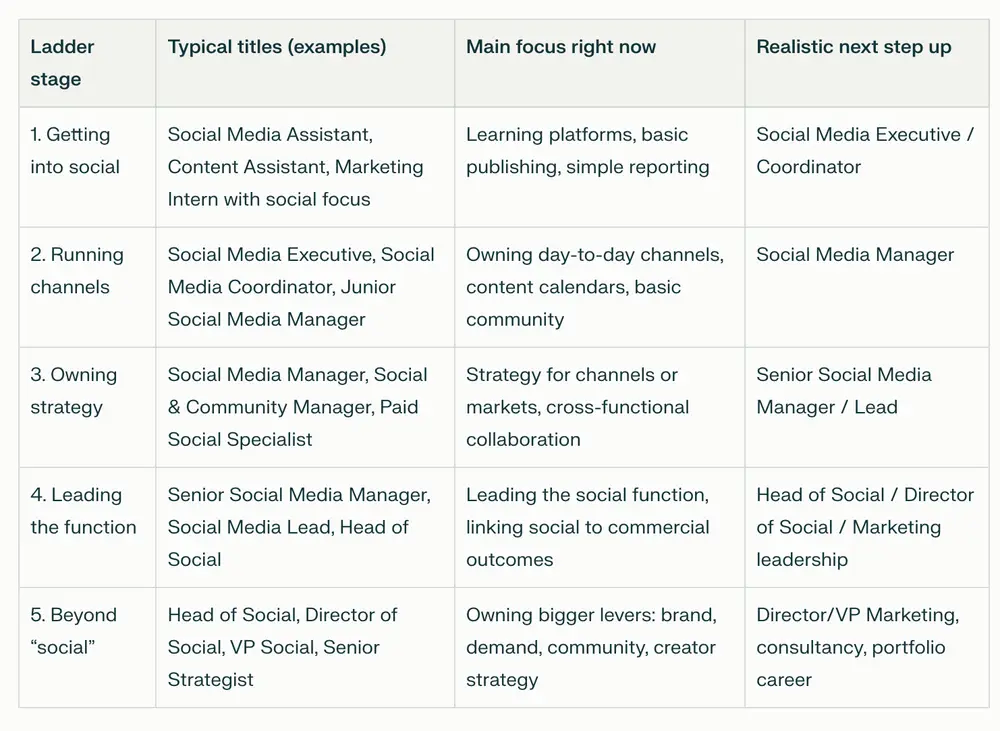
These rungs show up in different ways in‑house, at agencies and for freelancers - but the underlying progression is similar.
Stage 1: Getting into social
Typical roles
- Social Media Assistant
- Content/Community Assistant
- Marketing Assistant or Intern with a social remit
What this stage is really about
At this level, you're learning the basics: how to publish, how the platforms work, how not to break anything. You're supporting - not owning - channels. You're close to the content, the comments and the day‑to‑day reality of what audiences actually do.
You're not expected to be "strategic" yet. You're expected to be reliable, curious and fast to learn.
Skills that help you move up
To move from "supporting" to "running", focus on:
- Craft: writing clear, on‑brand copy; understanding hooks, structure and basic storytelling for each platform.
- Platform literacy: knowing the basic features and formats across key platforms, and how people actually use them.
- Data basics: reading platform analytics well enough to spot simple patterns (what got more saves, shares or replies - and guessing why).
- Process: following workflows, hitting deadlines, keeping assets organised.
Signals you're ready for the next rung
You're ready to step into an Exec/Coordinator role when:
- You can take a brief and turn it into a full week of content with minimal hand‑holding.
- You can explain, in simple language, why one post performed better than another.
- Your manager starts trusting you with publishing, not just drafting.
Stage 2: Running channels (Exec / Coordinator)
Typical roles
- Social Media Executive
- Social Media Coordinator
- Junior Social Media Manager
- Community & Social Executive
What this stage is really about
Now you're the one actually driving the channels day to day. You're planning content calendars, posting, responding, escalating issues and doing first‑line reporting. You often sit between strategy and execution, translating ideas into actual posts.
You're still judged on consistency and quality, but you start to feel the pressure of results: "What did this do?" rather than just "Did it go out on time?".
Skills that help you move up
To move towards Social Media Manager, you need to add:
- Planning: shaping simple content plans that ladder up to bigger goals (launches, campaigns, product pushes).
- Basic strategy thinking: understanding the difference between awareness, consideration and conversion content, and deliberately creating for each.
- Stakeholder communication: sending clear updates, owning small pieces of reporting, and confidently explaining your decisions to non‑social people.
- Channel ownership: spotting issues before they become problems - from negative comments to broken links.
Signals you're ready for the next rung
You're ready for a Social Media Manager role when:
- You can own a channel or market end‑to‑end for at least one brand.
- You're the person colleagues come to with "Will this work on social?" questions and you have a clear answer.
- You can connect your activity to simple business goals (e.g. "This series is to drive webinar sign‑ups; we're measuring clicks and DMs, not just views.").
Stage 3: Owning strategy (Manager / Specialist)
Typical roles
- Social Media Manager
- Social & Community Manager
- Global/Regional Social Media Manager
- Paid Social Specialist or Performance Social Lead
What this stage is really about
This is the level a lot of people think of when they hear "Social Media Manager" but in 2026 it's bigger than just "posting". You're responsible for strategy on one or more channels, brands or markets. You make choices about what to do and what not to do. You co‑create campaigns with other teams.
You're expected to talk in the language of commercial outcomes, even if you don't fully own the numbers yet.
Skills that help you move up
To move from Manager to Senior/Lead, you need to build:
- Pattern recognition: using data to see what consistently drives meaningful actions (saves, sign‑ups, DMs, applications) not just chasing spikes.
- Commercial awareness: understanding how your work affects leads, sales, reputation and recruitment, and prioritising accordingly.
- Cross‑functional collaboration: working with product, sales, customer support, HR and PR so social isn't operating in a silo.
- Campaign ownership: running multi‑week or multi‑channel campaigns from brief to wrap‑up, and turning results into learnings.
Signals you're ready for the next rung
You're ready for Senior Social / Lead when:
- You're already the de‑facto strategist for at least one area (a product line, a region, a channel).
- You can walk leadership through a plan and a report without your manager in the room.
- You can clearly answer the "How is this actually going to grow the business?" question for your content.
Stage 4: Leading the function (Senior / Head of Social)
Typical roles
- Senior Social Media Manager
- Social Media Lead
- Head of Social / Head of Social & Content
- Head of Community & Social
What this stage is really about
Here, you're no longer just running channels - you're leading the function. You're setting vision and direction, building or influencing the team structure, and using social to support company‑level objectives. You're in more meetings, closer to the P&L, and closer to senior leadership expectations.
Your job is as much about people, budgets and politics as it is about platforms.
Skills that help you move up
To move into full Head/Director level, focus on:
- Leadership: managing people, giving feedback, handling conflict and creating a sane working environment in a high‑pressure discipline.
- Budget & resource planning: making the case for headcount, tools and agencies and proving the return.
- Narrative building: telling the story of what social is doing for the business in a way leadership understands and backs.
- Risk management: handling crises, reputation issues and platform changes without panic.
Signals you're ready for the next rung
You're ready for Head/Director‑level or broader marketing leadership when:
- You're already shaping brand and campaign decisions beyond "the social bit".
- You can defend or adjust budgets based on clear data and business context.
- People outside marketing see you as a strategic partner, not a "posting person".
Stage 5: Beyond "Head of Social"
Typical roles
- Head of Social / Director of Social / VP Social
- Director/VP Marketing with social background
- Head of Creator & Community, Head of Advocacy
- Independent strategist, consultant, trainer, agency owner
What this stage is really about
At this level, social is your background - not your whole job title. You're working on bigger levers: brand, demand generation, community, product launches, creator partnerships. You're hiring or managing people who run social; you're focused on direction, priorities and outcomes.
For independents, it might mean blending consulting, training, speaking and building products or programmes for the industry.
Skills that help you move up (or out)
- Vision and positioning: defining where the brand sits in the market and how social helps anchor that story.
- Business fluency: reading a P&L, understanding margins, and making decisions that factor in more than just marketing metrics.
- Ecosystem thinking: connecting social to CRM, events, SEO, PR, sales - so it works as part of a system, not a silo.
- Personal leverage: using your own reputation, network and thought leadership to open doors for your team and your brand.
The real career framework: skills that move you up
Titles change from company to company. The underlying progression doesn't. You can think of your career as three overlapping ladders:
- Craft ladder - your ability to do the work
- Commercial ladder - your ability to connect work to business outcomes
- Meta‑skills ladder - your ability to handle complexity, humans and yourself
- Here's how that plays out across levels:
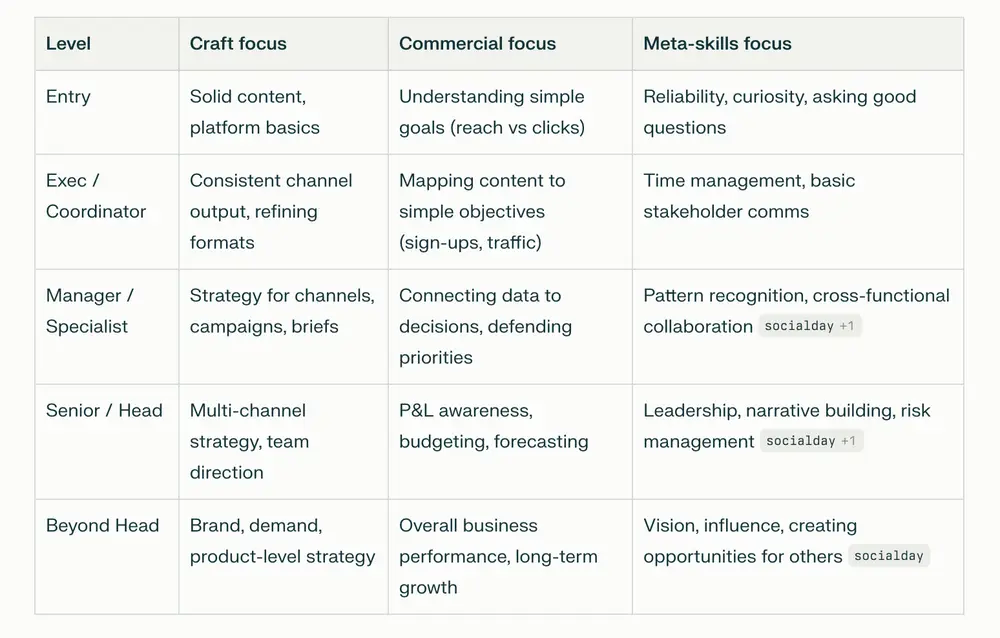
If you feel "stuck", it's often because you're only climbing the craft ladder, getting better at content, without showing progression on the commercial or meta‑skills side.
How to use this ladder in your own career
Here's a simple way to turn this into an action plan.
1. Identify your current rung
Write down:
- The rung you're on (using the table above).
- One rung above where you'd like to be within 12 - 18 months.
2. Map expectations vs reality
For your current rung, ask:
- What does my company actually expect from someone at this level?
- What am I already doing that's "above my rung"?
- Where am I still behaving like the rung below me?
Be honest. If you want to be a Manager but still only think in posts, not campaigns, that's your gap.
3. Pick 2 - 3 skills to deliberately grow
Choose from the skills lists above, then make them visible:
- Add them to your development plan.
- Ask your manager for projects that stretch those muscles (e.g. owning the next campaign report; joining cross‑functional planning; leading a mini‑project).
- Track examples where you used those skills, they become your promotion evidence.
4. Remember the human side
Every rung up usually comes with more responsibility, more visibility and more emotional load. Progression is great, but not if it comes with burnout and resentment.
Protect yourself by:
- Setting clearer boundaries around availability and response times.
- Using tools and workflows so you're not "on" 24/7.
- Building community with other social pros who understand the reality of the work.
If the first career ladder was about naming the rungs, this one is about giving you something you can actually use: a way to work out where you are, what's expected at your level, and what you need to show to move up. The roles will look slightly different in every organisation, but the underlying progression - from craft, to commercial impact, to leadership - stays surprisingly consistent.
If you haven't read the original Social Media Career Ladder framework yet, go back to that piece next and map your current role against it - then use this article to fill in the gaps and turn it into a plan. And if you want more help doing that in practice, keep an eye on SocialDay: we'll be talking about progression, meta‑skills and the future of social careers at our upcoming events, and sharing more resources, templates and real‑world examples in The Sauce and across our channels.