
Most employee advocacy programmes fail in the same quiet way. People are asked to post, a flat incentive is offered, and the content that comes back is safe, sparse and indistinguishable from the company page it was meant to supplement.
Victoria Ivanova's starting point at fatjoe. was that flat-rate pay creates flat content. The programme she built is an incentive-based LinkedIn initiative designed to turn employees into authentic brand voices without a ghostwriter, an agency or an enterprise budget, and it rewards content quality rather than content volume.
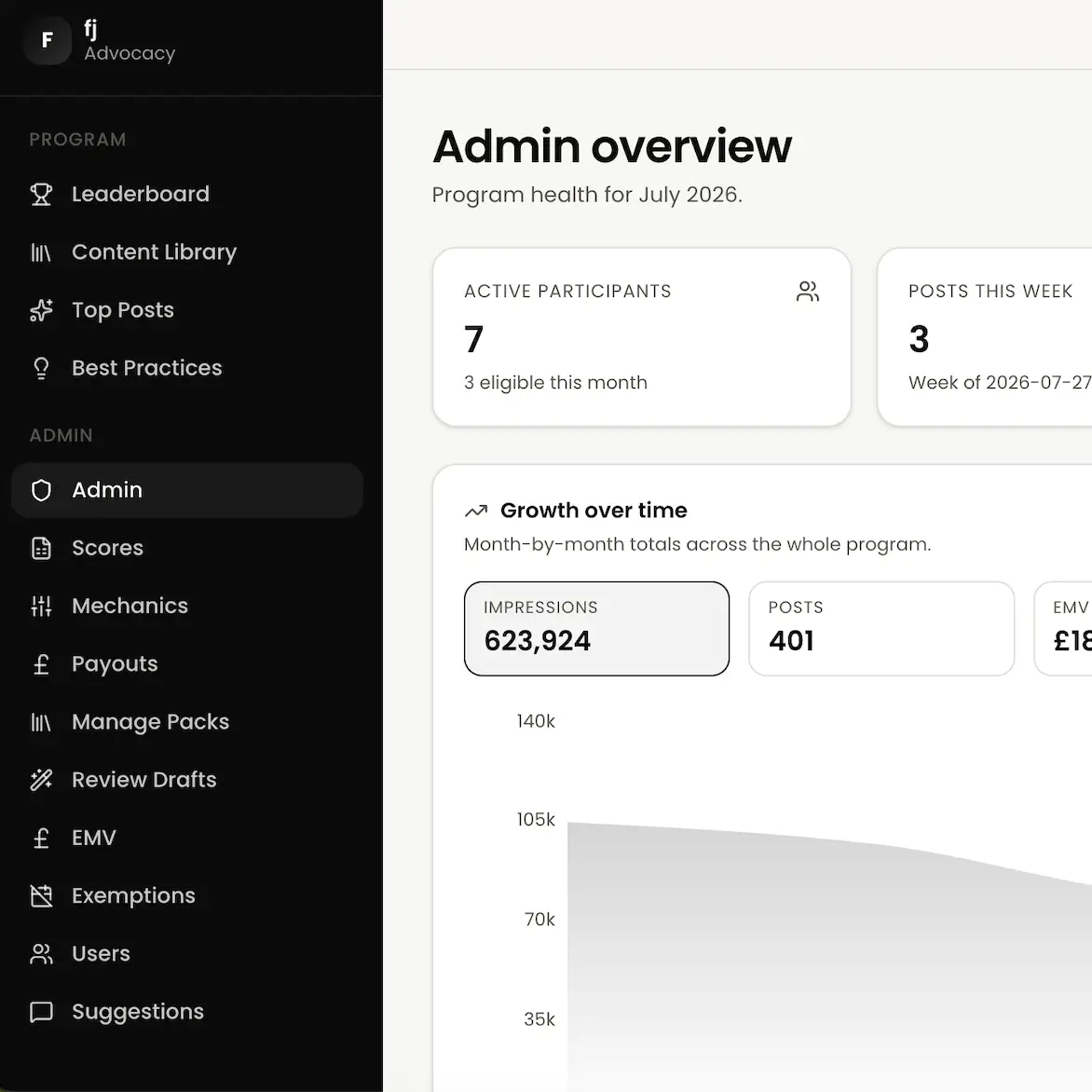
It runs on a custom scoring system, a competitive monthly leaderboard and a lightweight app built from scratch in Lovable. What Victoria argues makes it award-worthy is not simply the results but the model itself, which is a fairer and smarter way to run employee advocacy that any growing company could replicate.
Scoring signals by how hard they are to fake
The mechanics are where the thinking sits. The scoring system weights engagement signals according to how difficult they are to fake, so reposts are worth the most and impressions the least, with a per-post cap that rewards consistency rather than a single lucky post.
The programme started with five people who were already posting naturally rather than trying to convert reluctant participants first. A coaching hire that did not work was replaced with an AI workshop, and when off-the-shelf advocacy platforms did not fit how the company actually operates, the team built its own tooling instead.
Victoria is Brand Manager at fatjoe. and built the programme from the ground up, including the strategy, the scoring mechanics, the leaderboard and the app itself, as a one-person brand and social team inside a larger marketing team.
What a founding cohort of five produced
Since launching in February 2026, the programme has generated 623,924 impressions across 401 posts, with 11,389 reactions, 3,748 new followers and an estimated media value of £18,718.
The individual outcomes are the part Victoria draws attention to. Francis gained nearly 1,000 new followers and started receiving inbound approaches from companies wanting to work together. Leah landed two podcasts and a mentoring opportunity, brought in new clients for fatjoe. and had leads tell her directly that they had heard about the company through LinkedIn, with journalists beginning to approach her first. Angela joined in April with no warm-up period and doubled her following inside a month.
All of that came from a founding cohort of five people and a monthly budget of less than £600.
You cannot hire someone to give your team a voice
The central lesson Victoria takes from it is that a team already has a voice, and the job is to hand them the microphone and get out of the way. The coaching model did not fail because the people were wrong but because the approach was, since authentic content cannot be outsourced. The moment the company stopped trying to give people a voice and started building the conditions for them to use their own, the programme shifted.
Her second conclusion is that incentives shape behaviour more effectively than encouragement does, and that a well-designed scoring system does more for content quality than any amount of internal cheerleading. Get the mechanics right, she argues, and the culture follows. The third is to build for how an organisation actually operates rather than how it thinks it should, which is why the Lovable app worked where a template designed for someone else would not have.
Employee advocacy tends to live in the shadow of brand accounts and paid campaigns, and Victoria's hope is that being shortlisted gives the discipline a moment in the spotlight and encourages more marketing teams to take it seriously. She is also clear that recognition for the programme is recognition for the people in it, who put in real effort, showed up consistently and built personal brands that opened doors they had not expected.
The programme is now open to the whole fatjoe. team, which makes scaling without adding manual overhead the next problem. Participants currently submit their statistics manually, and the plan is to build a bot that scrapes public LinkedIn data so scores calculate automatically without screenshots. That would also allow the scoring formula to evolve as the team learns more about which signals actually drive results, rather than being fixed from day one. The broader ambition is a programme that runs itself and gets sharper the longer it runs.
The winner of Employee Advocacy or Social Selling Programme at the Social Media Marketing Awards will be announced at the awards ceremony on 8 October in London.